
PublishDrive 2025: The Year We Turned AI Promises Into Publishing Reality
Ten years ago, we founded PublishDrive on a simple premise: authors and publishers deserved better infrastructure to reach readers globally. In 2025, that premise was tested in ways we couldn't have imagined a decade ago.
This was the year AI stopped being a theoretical disruption and became an actual workflow. The year European accessibility regulations moved from "eventually" to "immediately." The year distribution partners we'd relied on for years simply shut down. The year fraud became sophisticated enough to require machine learning to combat it.
Here's what actually happened in 2025, what we learned, and what it means for professional publishing.
The Audio Revolution Hit Critical Mass
The US audiobook market generated $1.1 billion in 2024, growing nearly 24% year-over-year. Digital audio now commands 11.3% of the US trade market—decisively surpassing ebooks. At PublishDrive, our audiobook distribution revenue quadrupled in 2024, and 2025 maintained that momentum.
Our ElevenLabs partnership wasn't just a tactical integration—it was a strategic commitment to helping publishers build new revenue streams through AI technology. We developed the 70-20-10 framework: 70% of backlist converted with AI narration, 20% hybrid production, and 10% premium human narration for frontlist and key titles.
On the PublishDrive platform, the number of audiobook titles, spanning various languages, surged by over 80%. We anticipate that this strong growth will persist in 2026.
What's remarkable isn't just adoption rates—it's sophistication. Publishers quickly learned strategic deployment. One romance publisher told us they'd spent years watching ebook sales stagnate while knowing audio was the growth format, but human narration quotes of $2,000-5,000 per title meant their $4.99 backlist would never break even. With AI narration, they converted dozens of titles in a few months and added substantial new monthly income from audiobooks.
That's not replacing human narrators. That's creating economic viability where none existed before. The publishers who thrived understood AI narration as a tool for backlist monetization while maintaining human narration for premium frontlist titles where voice performance drives value.
Our ElevenLabs partnership extends beyond production to reader experience technology—publishers can now offer AI-narrated previews and full audiobook experiences directly through retail channels, improving discoverability and conversion.
The publishers who won in 2025 weren't using AI for everything or avoiding it entirely. They were strategic, testing, and making data-driven decisions about which titles deserved complete human treatment and which benefited from faster, cheaper AI production.
Amazon's 2025: Platform Risk Crystallized
Amazon didn't just adjust print royalties in June 2025—they increased both prices AND royalties, opened Kindle Unlimited to libraries, and launched a translation tool in beta. Also, at the end of the year, they announced that readers can chat with AI agents about the books, plus readers can download epubs and PDF versions of the books (without digital right management). Each change, whether beneficial or not, reminded publishers of a fundamental truth: when one company controls your distribution, you're not running a business—you're renting one.
But Amazon wasn't the only major player changing terms. Ingram introduced new terms and conditions across IngramSpark and other services, such as CoreSource, affecting print-on-demand economics for thousands of publishers. The changes affected setup fees and distribution terms, shifting costs back to publishers. For small presses and independent authors who'd built their print strategy around Ingram's infrastructure, this represented yet another reminder that platform terms are always subject to change.
We saw immediate spikes in inquiries from a wide distribution perspective after each announcement. Publishers who'd been KDP-exclusive for years suddenly wanted options.
When Distribution Partners Disappear
Baker & Taylor's shutdown sent shockwaves through the library distribution industry. Ciando's closure affected European ebook publishers. Both reminded us that even established players aren't permanent.
PublishDrive's multi-channel approach meant our publishers had backup routes to the same retailers and libraries. When one partner shut down, complexity became resilience.
AI's Double-Edged Sword
The Disney v. Midjourney lawsuit crystallized everything uncertain about AI and copyright. As the case proceeds, it's already changed conversations about training data and author rights.
Meanwhile, AI simultaneously became a normalized production workflow AND a fraud vector. Publishers used AI for narration, cover design iterations, metadata optimization, and marketing copy. But AI also enabled content spam flooding retailers, the generation of fake reviews, and sophisticated rights fraud.
At PublishDrive, we turned AI promises into publishing reality by strategically addressing the challenges and opportunities of AI. We prioritized robust fraud detection to combat AI-generated spam while actively supporting legitimate AI use. This commitment involved significant investment in both development resources and human processes to ensure we could fairly mitigate the flood of low-quality, AI-generated content, protecting the integrity of the market.
The challenge isn't AI itself—it's that AI amplifies both efficiency and malicious fraud. Our position remains clear: authors own their work, and platforms must protect that ownership while enabling beneficial AI applications.
Platform Evolution: Features That Mattered
EAA Compliance Automation: The European Accessibility Act requires digital publications to meet accessibility standards, with enforcement ramping up through 2027. For publishers with extensive backlists, manual redesign would cost thousands of hours and be a significant expense. We built full automation—upload existing files, and our tool handles compliance conversion automatically. No manual redesign. No specialized designers. No panicking about EU regulations. Since the end of June 2025, all books uploaded and distributed through PublishDrive have been fully EAA-compliant.
This isn't just a feature—it's a strategic moat. Every publisher with EU distribution will need to republish their backlist to comply within the next 2-3 years. When they do, PublishDrive becomes the obvious solution. This is essential infrastructure disguised as compliance tooling.
Fraud Prevention: We implemented advanced fraud detection as a core platform capability to combat AI-generated spam content. Clean data protects publisher reputations, maintains retailer trust, and ensures platform integrity. In an industry plagued by fraud that erodes trust between platforms, publishers, and retailers, this essential infrastructure took years to build correctly.
AI-Powered Metadata Optimization: Our tool analyzes manuscripts and suggests optimal BISAC codes and keywords across retailers. Remember when optimizing categories felt like reading tea leaves? We solved that.
Team Royalties: We reduced pricing to a flat $20 fee for unlimited contributors (down from $20 per contributor) and automated split payments for publishing houses managing multiple authors. The price reduction made this function for smaller houses more accessible, since they needed it most.
Building Community Beyond Software
In 2025, PublishDrive affirmed a core belief: community, not just software, is the foundation of a sustainable business. We deepened our commitment to the publishing industry by engaging with key organizations, including the Independent Book Publishers Association (IBPA) and The Alliance of Independent Authors (ALLi).
Substantive Community Contributions
Our dedication went beyond marketing. The Brave New Bookshelf podcast, hosted by Danica Favorite with Steph Pajonas, grew into a significant industry resource, exceeding 59 episodes and 94,000+ listens, and earning recognition at different conferences. Some of the episodes cover writing with AI or industry impact of using AI. This podcast is far from being a mere lead-generation tool, the podcast offered substantive conversations with authors, publishers, and experts, helping the community make better decisions. The fact that it aids in PublishDrive's discoverability is a secondary benefit, not the main objective.
Additionally, we hosted 12 webinars for our clients and prospects, aimed at maximizing their understanding and use of our platform's capabilities.
Active Conference Presence: Embedded in the Industry
We significantly boosted our conference presence in 2025, prioritizing active participation, speaking, and learning over simple attendance. Our attendance included a first-time appearance at the U.S. Book Show (USBS) in New York and participation in the Sharjah Publishers Conference.
- At USBS: Discussions about AI, discoverability, and the future of audiobooks directly reinforced our internal focus areas, giving us real-time insights from publishers navigating these challenges.
- At Sharjah: Engaging with sophisticated conversations on Arabic-language publishing, translation rights, and global distribution challenges solidified our view: the future of publishing is global, extending beyond the Anglo-American market.
- At IBPA conference: PublishDrive was able to meet small and indie publishers from the US market and showcase how digital publishing is moving forward.
- At Author Nation: Danica Favorite had several speaking engagements about PublishDrive and how AI is shaping the industry.
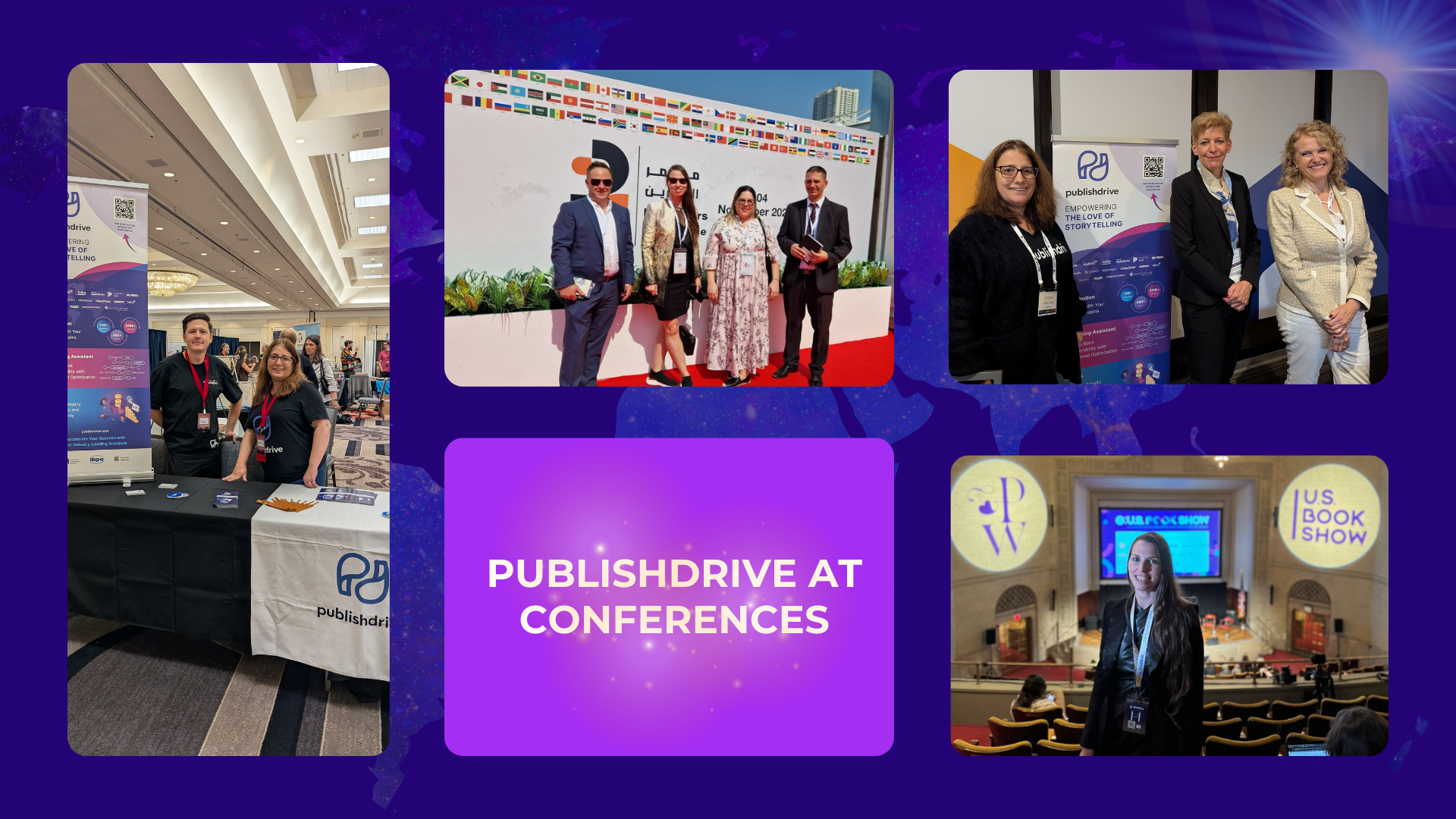
This active involvement is critical because PublishDrive is not an external "disruptor." We are embedded in publishing, constantly learning from industry professionals. Every conference provided valuable lessons that directly influenced our 2025 roadmap, every podcast conversation surfaced actionable pain points, and every community interaction reinforced the foundational mission of PublishDrive.
Internal Milestones: Our 10th Anniversary
PublishDrive turned 10 in 2025. A decade in publishing technology is an eternity—think about how much has changed since 2014. The fact that we're still here, still independent, still growing, and still focused on our original mission feels significant. Ten years taught us that sustainability beats viral growth, that publisher relationships matter more than vanity metrics, and that boring infrastructure work often delivers more value than flashy features.
We underwent a brand refresh in the last quarter of the year to reflect who we'd become: not a scrappy startup, but a mature platform serving professional publishers globally. Rebrands are risky, expensive, and potentially confusing to existing customers—but after 6 years of our last brand identity change, our visual identity needed to match our capabilities.
The website rebranding significantly improved the user experience, with the pages that matter most converting better: Traffic to sign-up rate grew by about 5%; Registration page views increased by 120.55%; and Pricing page views by 16.45%.

Prioritizing Decisions That Benefit the Customer
We made the controversial decision to offer actual support to free-tier users, not just paid customers. Most SaaS companies reserve support for paying customers—it's economically rational. But we kept hearing from authors just starting out who needed guidance, from publishers testing the platform who had questions, from creators who would become paying customers if they understood how to use the system effectively. Did it strain our support team? Yes. Did it convert more free users to paid plans? Yes. Was it the right thing to do for the publishing community? Absolutely.
We introduced hybrid pricing plans mixing royalty-share and subscription models, acknowledging that a publisher with 500 backlist titles has different economics than one releasing 20 frontlist titles annually. We negotiated a 12-month Ingram fee waiver for our publishers. We integrated ElevenLabs Reader technology, enabling AI-narrated previews directly through retail channels, improving audiobook discovery and conversion.
Partner and Publisher Success
Here's the thing about running a platform business: our success is entirely derivative. If our publishers don't succeed, we don't succeed. It's that simple.
So while I've spent much of this article discussing PublishDrive's features and growth, what actually matters most is what our partners and clients achieved in 2025 because they're the ones doing the hard work of writing, editing, publishing, and connecting with readers.
Let me just mention one specific example, Defiance Press. They moved their catalog to PublishDrive in 2025, and their audiobook business is already about 15% of their overall revenue this year. As Lisa Woodward from Defiance Press stated: ‘Moving the Defiance Press catalog to PublishDrive in 2025 was the best thing we could do for our company and authors.‘
PublishDrive's 2025 Growth Highlights
PublishDrive and its network of publishers achieved significant platform-wide growth in 2025 (based on strong current projections):
- Sales and Royalties: Book sales increased by approximately 20% over 2024, resulting in a 35% rise in total royalties earned.
- Platform Adoption: We saw a 25% increase in new publishers and authors joining the platform. The majority (around 60%) of new users came from the US and the UK, with the remainder from various countries, including Australia, Canada, Italy, China, the United Arab Emirates, Hong Kong, Germany, and Switzerland.
- Format Expansion: Growth was strongest in new formats, demonstrating publishers' willingness to utilize the platform beyond ebooks:
- Audiobooks published increased by over 80%.
- Print-on-demand books added increased by more than 70%.
- Distribution Network: Elevenlabs, with their Elevenreader store, was added as a key distribution partner, continually expanding ways to sell more books.
- Sales Channel Performance:
- Regional stores showed the highest growth (52%).
- Retail models grew by 44%.
- Library sales saw a 26% increase, with stronger growth anticipated in 2026 following KU's opening to library sales.
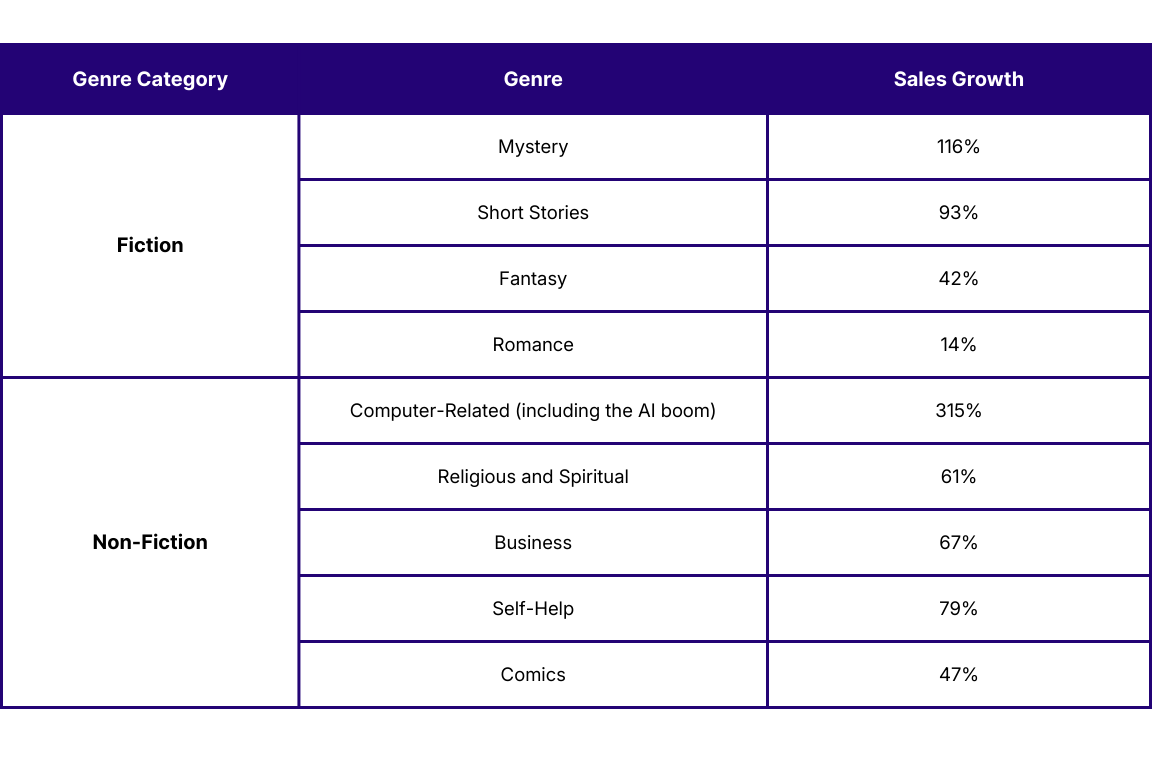
Genre Performance Snapshot
Several genres experienced exceptional growth in 2025:
Why This Matters for the Industry
PublishDrive has built sustainable competitive advantages over a decade:
Distribution Infrastructure: Building relationships with 400+ retailers and 240,000 libraries took ten years of partnership development, technical integration, and trust-building. This network isn't easily replicated—it represents accumulated relationship capital and technical infrastructure that competitors would need years to match.
EAA Compliance Automation: We've solved the European Accessibility Act compliance challenge that will force every EU-facing publisher to redesign their catalog in the next 2-3 years. Our automated, full-stack solution positions us to capture significant catalog migrations as compliance deadlines approach, and publishers face the choice between expensive manual redesign or switching to PublishDrive's automated solution.
Fraud Prevention Infrastructure: Our advanced fraud detection protects publisher reputations, maintains retailer trust, and ensures data integrity. In an industry plagued by click farms, review manipulation, and AI-generated spam, this infrastructure took years to build correctly and represents essential platform integrity that can't be bolted on later.
Strategic AI Partnerships: Our ElevenLabs integration isn't just a feature—it's a long-term partnership positioning us at the forefront of AI narration technology evolution. We're helping publishers build new revenue streams through strategic AI deployment, not chasing hype cycles. This partnership model demonstrates our approach: integrate deeply with best-in-class AI providers while maintaining platform independence and publisher control.
Publisher Trust and Retention: We have more and more publishers joining our platform because we solve real problems, not because of lock-in contracts. Our zero-commission subscription model aligns our interests with publisher success—we succeed when they succeed. This alignment creates sustainable growth rather than extractive relationships.
Community Engagement: Through Brave New Bookshelf (59 episodes, 94,000+ listens), expanded global conference presence (USBS, Sharjah, Frankfurt, Author Nation, NINC), and consistent educational content, we've built trust and brand recognition beyond feature comparisons. Publishers choose platforms they trust, and trust is built through consistent community contribution, not just marketing spend.
As the market evolves—traditional publishers building technology capabilities, technology companies exploring publishing—PublishDrive represents something increasingly rare: mature technology infrastructure combined with real publishing expertise, established distribution networks, and sustainable business models. We're one of the few scaled independents in an increasingly consolidated market.
2026: What's Next
We're watching AI voice personalization (letting readers choose voice, accent, and pacing), multilingual expansion enabled by AI translation plus narration, direct-to-reader infrastructure as subscription services squeeze margins, and expanded fraud prevention.
EAA compliance becomes our competitive advantage as enforcement accelerates. We're doubling down on data-driven publishing decisions, making our sales intelligence across 400+ retailers more actionable. Our 2026 goal is to make sure we give the best support for our clients who go wide with all the tools we already built and to offer the best customer experience to empower their publishing journey.

2026 Publishing Predictions
Want to know where the industry is moving in 2026? Check out my Publishing Predictions article with insights from many of the industry's top voices.
As we head into 2026, the publishing industry stands at a fascinating crossroads. After years of chasing every new platform, trend, and technology, we're seeing a fundamental shift toward strategic focus, catalog optimization, and—perhaps most importantly—authentic human connection in an increasingly AI-powered world.
READ IT NOWThe Publishing Industry in 2025: Final Thoughts
Barriers to entry have collapsed—anyone can publish now. This is wonderful for creative expression and terrifying for discoverability. But quality still matters. Readers remain discerning, and algorithms have improved at surfacing quality content.
The relationship between authors and publishers continues evolving. Traditional publishing's value proposition faces pressure. Self-publishing is increasingly professional. Hybrid models proliferate. There's no single "right" path anymore.
Copyright and IP rights will define the next decade. How we resolve AI training debates will determine whether individual creators can make sustainable livings or whether content becomes a commodity.
Community matters more than ever. BookTok, reading challenges, subscription boxes, and direct author-reader relationships drive discovery and sales. Publishers who understand community building will outperform those who only understand distribution.
Thank You
What kept me going: every time a publisher messaged us to say they'd just had their best month ever, or that PublishDrive's distribution helped them reach readers in a country they'd never imagined, or that our AI narration integration let them finally afford to convert their backlist to audio.
This is why we built PublishDrive. Not to be the biggest or the flashiest, but to genuinely help authors and publishers build sustainable businesses.
To our publishers: Thank you for trusting us with your work. We don't take that lightly.
To Danica Favorite: Building Brave New Bookshelf into something mentioned at Sharjah—that's the kind of team win that reminds you why you started a company.
To our incredible PublishDrive team from 9 countries globally who shipped more in 2025 than in 2024. Thank you for working hard for our customers.
To our retail partners and readers: None of this exists without you.
The publishing industry is messy, complicated, and beautiful. AI is making it messier and more complicated, but also more accessible and potentially more beautiful.
PublishDrive isn't trying to "disrupt" publishing. We're trying to empower the people who make it work—the authors, publishers, and readers who care about stories.
That was true when we started. It was true in 2025. It'll be true in 2035.
Thanks for being part of this journey.

Kinga Jentetics is CEO and co-founder of PublishDrive, a global book distribution platform serving publishers and authors in over 100 countries. Connect with her or subscribe to her newsletter "Wide Margins" on Substack.
CONNECT ON LINKEDIN