
How to Publish a Book in Multiple Languages: The Complete Guide

To publish a book in multiple languages, validate demand in your original language, commission professional literary translation or use AI-assisted translation with human editing, localize all metadata (title, description, keywords) by a native speaker, set market-specific pricing per format, and distribute globally through an aggregator like PublishDrive — reaching Amazon, Apple Books, Kobo, Tolino, and 400+ stores worldwide from one dashboard.
- English still dominates volume — roughly 67% of titles sold through PublishDrive — but non-English languages are growing at 2–3× the rate of English.
- German (+101% YoY), French (+96%), and Spanish (+42%) are the three highest-momentum language targets for indie authors and independent publishers within the PublishDrive network right now.
- Translation ≠ localization. Translation converts the manuscript text. Localization adapts everything — metadata, cover, pricing, and distribution channels — so the book feels native to the target market. Both are required for competitive performance.
- Genre-market fit matters. Romance → Spanish & Portuguese. Mystery & Detective → Italian, German, French, Brazilian. Fantasy → Dutch, Swedish, and smaller European languages.
- Pricing should be set per market, not converted from your home price. German ebooks average ~$6.56 versus ~$4.75 in the US — a built-in margin advantage for translated editions.
- Tolino — the major German bookseller ebook alliance — grew +869% YoY within Germany through PublishDrive. Reaching it via an aggregator is essential for capturing growth in the German market. Similarly, Kobo and Kobo Plus are critical for non-English readership across Canada, France, and the Netherlands, while Apple Books serves as a major gateway for readers in France, Germany, Italy, and Spain.
- The global literary translation market is projected to grow from ~$19.8B (2025) to $32.4B by 2034, driven by digital publishing and indie-author demand.
- Source: Primary data in this article is drawn from the PublishDrive Market Intelligence Report 2026, covering full-year 2025 vs. 2024 transactional data across 100+ countries.
| Language | Revenue Growth (YoY) | vs. English (+33%) |
|---|---|---|
| German | +101% | 3× faster |
| French | +96% | ~3× faster |
| Spanish | +42% | 1.3× faster |
| English | +33% | Baseline |
If you want to know how to publish a book in multiple languages, the data has never been clearer: independent publishing is no longer a single-language, single-market game. PublishDrive — an Aggregator and Market Intelligence platform for independent authors, serving self-published authors and independent publishers across more than 400 retail, subscription, and library channels worldwide, including Amazon, Apple Books, Google Play Books, Kobo, and the Tolino alliance — shows that English represents about 67% of titles sold — yet several non-English languages are expanding at more than double its rate. For authors and publishers with a proven book, leveraging professional book translation services has become one of the clearest paths to new revenue. This guide walks through data on where multilingual demand is growing, which genres travel best to which markets, how to price and localize, and how to achieve global book distribution for translated editions — across major platforms like Apple Books, Kobo, Tolino, and hundreds of regional retailers.
Before diving into market data, it is worth drawing a clear distinction between two terms that are often used interchangeably but describe fundamentally different scopes of work — especially in the context of independent publishing.
Translation, in the context of indie publishing, refers to the conversion of a book's manuscript from one language to another, with the goal of accurately conveying meaning, voice, and narrative in the target language. It is the core task: a professional literary translator reads your English romance novel and produces an equivalent German text. Translation is word- and sentence-level work. Its output is a readable manuscript in a new language.
Localization goes further. In indie publishing, localization is the process of adapting a book — and everything surrounding it — so that it feels native to a specific market, culture, or regional audience, not merely translated. Localization includes:
- Metadata localization: Rewriting titles, subtitles, descriptions, keywords, and category selections in the target language using native-speaker idiom, not word-for-word translation. A title that works in English may need creative rethinking to resonate in French or German search environments — whether on Apple Books, Kobo, or local retailer storefronts.
- Cover and visual localization: Adapting cover design to regional genre conventions. A German thriller market, for example, has distinct visual conventions that differ from the US market.
- Pricing localization: Setting price points to match local reader expectations and purchasing norms rather than converting the home-market price at a currency exchange rate.
- Cultural adaptation: Adjusting idiomatic expressions, cultural references, humor, and contextual details within the manuscript so they land naturally for a reader in the target market — not just a reader who speaks the target language.
- Distribution localization: Selecting the right retail channels for each territory, including regional platforms such as Tolino — a network of major German booksellers operating as the primary regional ebook platform in the German-language market — Kobo for French Canadian and Dutch audiences, and Apple Books for Southern European markets, rather than relying solely on global retailers.
For independent authors and publishers, the practical distinction matters enormously: a book can be translated without being localized, and when that happens, it typically underperforms. A well-translated German manuscript with English metadata, a US-convention cover, and a price set by currency conversion is not a localized German book — it is a translated book with significant market-fit gaps. Successful multilingual publishing requires both: accurate translation as the foundation, and thorough localization as the layer that makes the book genuinely competitive in each market.
Why Publish in Multiple Languages Now?
The short answer is that growth in independent publishing is no longer concentrated in the English-language market. It is spreading across languages, regions, and formats. PublishDrive's Market Intelligence Report 2026 — an annual dataset derived from aggregated, anonymized sales transactions processed through PublishDrive's platform covering full-year 2025 versus full-year 2024 — shows total sales value up 33% year over year across the network, and much of the incremental acceleration is coming from outside core Anglophone markets.
Language composition remains structurally anchored in English — roughly 67% of titles sold through PublishDrive are in English, reinforcing its continued dominance in overall revenue scale. But dominance in scale is not the same as dominance in momentum. When you look at growth rates by language, the picture inverts:
| Language | Revenue Growth (YoY) | What It Signals |
|---|---|---|
| German | +101% | More than doubled — the standout multilingual opportunity, with strong performance on Tolino and Kobo |
| French | +96% | Near-doubling; strong across fiction and non-fiction, including on Apple Books and Kobo |
| Spanish | +42% | Broad-based expansion across Spain and Latin America |
| English | +33% | The scale anchor — largest base, steady growth |
This distinction between scale and acceleration is the core reason to consider multilingual publishing. English is where the volume is; non-English is increasingly where the growth is. Layering additional language editions onto a title that already performs is one of the highest-return moves available to a wide-publishing catalog.
The Wider Market Is Moving the Same Way — and Diverging from Traditional Publishing
PublishDrive's indie data doesn't sit in isolation. The broader translation economy is expanding rapidly: the global literary translation market was valued at roughly $19.8 billion in 2025 and is projected to reach $32.4 billion by 2034, with a compound annual growth rate of nearly 7%, driven by digital publishing, the expansion of audiobooks into dozens of languages, and demand from independent authors.
Translated fiction has also been winning over younger readers — industry reports point to a roughly 22% rise in translated fiction and graphic-novel sales among readers under 35. What's striking is how differently the independent market is behaving compared with traditional trade publishing.
According to NielsenIQ BookData and GfK Entertainment's International Book Markets 2025 report, several major European trade markets contracted last year — Italy declined by about 2.1%, France by about 1.5%, and the UK by about 0.5%. In PublishDrive's independent ecosystem over the same period, France and Italy grew roughly 70% each. The multilingual growth is real, but it is concentrated in wide, digital-first, indie distribution rather than the legacy retail channel. Platforms like Kobo, Apple Books, and Tolino are central to this digital-first expansion.
Global Book Distribution: The Fastest-Growing Markets to Translate Into
Language and geography aren't identical — a Spanish edition sells across Spain, Mexico, and much of Latin America — but market-level revenue growth is the clearest map of where translated editions find demand. These are the ten fastest-growing markets by year-over-year revenue in PublishDrive's Market Intelligence Report 2026:
| Rank | Market | Revenue Growth (YoY) | Primary Publishing Language(s) |
|---|---|---|---|
| 1 | Spain | +98% | Spanish |
| 2 | Portugal | +71% | Portuguese |
| 3 | France | +70% | French — distributed via Kobo and Apple Books |
| 4 | Italy | +70% | Italian — accessible via Apple Books and Kobo |
| 5 | Germany | +67% | German — led by Tolino alliance growth |
| 6 | Brazil | +37% | Portuguese |
| 7 | Ireland | +37% | English |
| 8 | Canada | +36% | English / French — strong Kobo market |
| 9 | Netherlands | +36% | Dutch (strong English readership) |
| 10 | Australia | +35% | English |
The concentration is unmistakable: continental Europe dominates the top of the growth table. Spain, Portugal, France, Italy, and Germany all grew faster than the largest English-language markets. For a publisher deciding where to invest translation budget, these five markets — and the four languages behind them (Spanish, Portuguese, French, Italian, plus German) — are the highest-probability targets. Reaching these markets effectively means distributing through the full range of regional and global retailers: Tolino for Germany, Kobo for France and the Netherlands, Apple Books for Italy, Spain, and France, and Google Play Books across all territories.
Importantly, this is momentum layered on top of scale, not a shift away from it. The largest absolute revenue markets remain the United States, United Kingdom, Germany, Canada, and Australia. English is still the foundation; multilingual expansion is the growth layer built on top of it.
Author-Led vs. Publisher-Led Markets: Where Each Segment Is Growing
Where you focus may also depend on whether you're an independent author or a professional publisher, because the two segments are expanding along different geographic pathways.
| Top Author-Growth Markets (YoY) | Growth | Top Publisher-Growth Markets (YoY) | Growth |
|---|---|---|---|
| United Arab Emirates | +365% | Portugal | +73% |
| Spain | +199% | Germany | +62% |
| France | +156% | Italy | +57% |
| Brazil | +130% | Spain | +45% |
| Japan | +99% | Netherlands | +41% |
| Ireland | +96% | France | +37% |
| Germany | +95% | Canada | +32% |
Independent authors are accelerating fastest in digitally accessible, cross-border retail environments — the UAE, Spain, France, Brazil, and Japan. This suggests indie authors are moving quickly and experimenting with pricing and format in emerging and non-English markets, taking advantage of wide-distribution platforms like Kobo, Apple Books, and Google Play Books that serve these territories without requiring local market infrastructure.
Professional publishers, by contrast, are strongest in structured European territories — Portugal, Germany, Italy, and Spain — where established distribution frameworks and regional retail alliances such as the Tolino network support scaled operations. Both segments point to the same conclusion: continental Europe and select international markets are where the multilingual opportunity is concentrated.
Book Translation Services by Genre: Which Genres Travel Best
Translation isn't uniformly rewarding across genres. A book's category strongly influences which markets will embrace it. PublishDrive's Market Intelligence Report 2026 genre-by-country data reveals clear affinities — match your genre to the market where that genre is surging.
Romance Book Translation: Strongest in Spanish- and Portuguese-Language Markets
Romance is a digital-first, translation-friendly powerhouse. Beyond its established English-language base on platforms like Amazon and Kobo, it recorded exceptional growth in Southern Europe — markets well-served by Apple Books and regional distributors.
| Market | Romance Revenue Growth (YoY) | Key Platform(s) |
|---|---|---|
| Spain | +163% | Apple Books, Kobo |
| Portugal | +122% | Kobo, Google Play Books |
| Australia | +47% | Amazon, Kobo |
| Germany | +40% | Tolino, Amazon |
| United States | +32% | Amazon, Kobo |
| Canada | +30% | Kobo stronghold |
| United Kingdom | +18% | Amazon, Apple Books |
Mystery & Detective: The Breakout Genre for Global Book Distribution
Mystery and Detective fiction was the fastest-accelerating fiction genre in the network, and its international spread is the standout story for anyone weighing translation. Growth ran into the triple digits across multiple European and Latin American markets — all accessible through global retailers like Apple Books, Kobo, and Google Play Books, as well as regional platforms like Tolino in Germany.
| Market | Mystery & Detective Growth (YoY) | Key Platform(s) |
|---|---|---|
| Italy | +252% | Apple Books, Kobo |
| Germany | +184% | Tolino, Amazon |
| Brazil | +174% | Google Play Books, Kobo |
| France | +159% | Kobo, Apple Books |
| Spain | +156% | Apple Books, Kobo |
| United Kingdom | +151% | Amazon, Apple Books |
| Australia | +126% | Amazon, Kobo |
| United States | +125% | Amazon, Kobo |
| Austria | +116% | Tolino, Amazon |
| Canada | +80% | Kobo, Amazon |
Fantasy: Anchored in English, Accelerating in Smaller European Markets
Fantasy is the single largest fiction category by scale (about 33% of fiction revenue), but its growth is now diversifying well beyond core Anglophone strongholds. While the US grew 21% and the UK 14%, several smaller European markets outpaced them — with Kobo playing a significant role in Dutch and Scandinavian readership.
| Market | Fantasy Revenue Growth (YoY) | Key Platform(s) |
|---|---|---|
| Netherlands | +61% | Kobo, Apple Books |
| Sweden | +51% | Kobo, Google Play Books |
| Hungary | +31% | Google Play Books, Kobo |
| Denmark | +30% | Kobo, Apple Books |
These figures signal a concentrated genre affinity that warrants translation into Northern and Central European languages through targeted book translation services.
Multilingual Book Pricing: Don't Just Convert Your Home Price
One of the most common and costly mistakes in multilingual publishing is setting foreign prices by simply converting the home-market price. Reader price expectations differ meaningfully by country, and PublishDrive's proprietary transaction data — drawn from actual point-of-sale transactions within its network, spanning retailers including Amazon, Apple Books, Kobo, and Tolino, segmented by format and market — clearly show those gaps. Germany is a useful example:
Average Price Points Sold in Germany (PublishDrive Market Intelligence Report 2026)
| Format | Germany Avg. Price | US Avg. Price (Reference) | Difference |
|---|---|---|---|
| Ebook | ~$6.56 | ~$4.75 | +38% vs. US |
| Audiobook | ~$6.98 | — | — |
| Print (POD) | ~$20.66 | — | — |
The German ebook price point runs roughly 38% higher than the US average — a direct margin advantage that improves the economics of translating into German. This holds whether you're selling through Amazon, Kobo, Apple Books, or the Tolino alliance. Audio and print, meanwhile, sit at somewhat different levels than in the US. A smart multilingual pricing strategy is set per market and per format, not applied globally. Localized pricing lets you capture value where readers pay more and stay competitive where they don't.
Format Strategy for Global Book Distribution
Which formats to prioritize also varies by territory. In Germany — the standout multilingual market — all three major formats grew strongly year over year, but at different rates:
| Format | Germany Growth (YoY) | Key Retail Channels |
|---|---|---|
| Audiobooks | +75% | Kobo, subscription platforms |
| Ebooks | +69% | Amazon, Kobo, Apple Books, Tolino |
| +60% | Print-on-demand via aggregator |
Performance there wasn't format-dependent so much as broad-based, rewarded by balanced participation across formats. In practice, that means a translated German edition benefits from launching in ebook, audio, and print formats together rather than as a digital-only edition.
Audiobooks in particular are worth attention in multilingual strategy: as major audio platforms expand their catalogs into dozens of languages, translated audio is an increasingly viable — and, in some markets, premium-priced — format. This is also where AI-assisted narration is lowering production barriers for lower-risk titles, though human narration continues to anchor audiobook revenue.
Case Study: Germany and the Tolino Effect on Multilingual Publishing
Germany deserves a closer look because it demonstrates why broad global book distribution — not just translation — unlocks multilingual growth. Germany is a structurally bilingual market within PublishDrive's ecosystem: English-language titles account for roughly 70% of German sales, while German-language titles represent about 28%. But German-language sales more than doubled year over year, outpacing English-language growth and reshaping the market's dynamics.
The engine behind much of that is regional retail. Amazon matters everywhere, but Germany's Tolino — a network of major German booksellers operating as the primary regional ebook retail alliance in the German-language market, competing with Amazon Kindle and accessible to independent publishers primarily through aggregator services such as PublishDrive — is difficult to reach directly and easy to reach through an aggregator.
| Metric | Growth (YoY) |
|---|---|
| Tolino & German store network within Germany | +869% |
| Tolino global network sales | +553% |
| Total German market revenue | +67% |
| German-language sales | +101% |
The lesson generalizes: in many non-English markets, a regional retailer you can't easily access on your own is precisely where the growth is. Germany has Tolino; France has strong Kobo and Apple Books penetration; other markets have their own local champions. Reaching them is as much a distribution problem as a translation one — and it is why using an aggregator that connects you to all of these platforms simultaneously is essential.
Germany also anchors the global publishing calendar through the Frankfurt Book Fair and Leipzig Book Fair, making it a strategic priority well beyond its sales figures.
Multilingual Publishing Workflow: A Step-by-Step Guide to Publishing a Book in Multiple Languages
With the data mapped, here is the complete multilingual publishing workflow — from choosing what to translate through to worldwide distribution. Following these steps in order gives you the best chance of a competitive launch in each target market.
Step 1: Validate the Book Before You Translate
Translation is an investment. Before committing budget, confirm that the title already sells in its original language and has a clear genre home in a high-growth market.
- Review your existing sales data and reader reviews to confirm proven demand in the source language.
- Identify which genre your book belongs to — Romance, Mystery & Detective, Fantasy, or another category.
- Cross-reference your genre against the market data above: Romance points toward Spanish and Portuguese; Mystery toward Italian, German, or French; Fantasy toward smaller European markets with strong fandoms.
- Consult the PublishDrive Market Intelligence Report 2026 for the full genre-by-country breakdown before finalizing your target language.
Step 2: Choose Your Book Translation Services Route
There are three practical paths for sourcing book translation services. Select the one that matches your quality requirements, timeline, and budget.
- Professional literary translation: Engage a qualified literary translator for the target language. This delivers the highest quality and is the standard for fiction and brand-sensitive non-fiction. Source translators through professional associations such as the PEN America Literary Translation program or the Institute of Translation and Interpreting.
- Foreign rights licensing: Pitch the rights to a publisher in the target territory. This shifts translation cost and marketing responsibility to them in exchange for a royalty — useful when you lack local reach or language expertise.
- AI-assisted translation with human editing: Use an AI translation tool as a first pass, then commission a native-speaker editor to refine the manuscript. This lowers cost for lower-risk or high-volume catalogs but requires a rigorous human editorial stage.
- Whichever route you choose, always budget for a native-speaker editorial pass before moving to the next step.
Step 3: Localize the Metadata, Not Just the Manuscript
Metadata localization is the highest-leverage, lowest-cost step in the entire multilingual publishing workflow. A well-translated book with English metadata will be invisible in local search — whether on Apple Books, Kobo, Tolino, or any regional storefront.
- Hire a native speaker of the target language to rewrite the title, subtitle, and book description — not machine-translate them.
- Research local-language keywords using the target store's search environment (e.g., the German Amazon store, French Apple Books, or Kobo's French Canadian storefront).
- Select the correct local-language BISAC categories or store-specific categories that match how readers in the target market browse.
- Enter all localized metadata into the PublishDrive distribution dashboard alongside the translated manuscript, keeping each language edition fully separated.
Step 4: Set Market-Specific Pricing Per Format
Pricing to the local market rather than converting your home price is one of the most financially significant decisions in multilingual publishing.
- Research the average price points in your target market and format. For reference, German ebooks average approximately $6.56 versus roughly $4.75 in the US — and this premium holds across Kobo, Apple Books, and Tolino.
- Set ebook, audiobook, and print prices independently for each territory — do not apply a single global price.
- Use your distribution dashboard to enter per-market, per-format prices before publishing the edition.
- Revisit pricing at least annually as market benchmarks shift.
Step 5: Publish Across Formats Where the Market Supports It
In strong markets, launching across all formats simultaneously captures more of the available demand than a digital-only release.
- Prepare ebook, audiobook, and print-on-demand files for the translated edition.
- For markets like Germany where all three formats grew strongly year over year, plan a simultaneous multi-format launch rather than a phased rollout.
- Evaluate translated audiobook production for languages where major audio platforms have expanded their catalogs — AI-assisted narration can lower production barriers for lower-risk titles, though human narration remains the standard for premium positioning.
- Confirm that all format files meet the technical specifications of your target distribution channels — including Kobo, Apple Books, Tolino, and Google Play Books — before submission.
Step 6: Distribute Wide — Including the Regional Retailers
Wide international book distribution is where much of the multilingual growth actually lives. Skipping regional retailers means skipping much of the momentum in non-English markets.
- Distribute to all major global retailers: Amazon, Apple Books, Google Play Books, and Kobo and Kobo Plus.
- Ensure the edition reaches key regional retailers — above all, Tolino for the German-language market. Access Tolino through an aggregator like PublishDrive rather than attempting direct access.
- Include subscription and library platforms in each target market to maximize discoverability and revenue diversification.
- Use a single aggregator like PublishDrive to manage every language edition, localized metadata, and per-market pricing from one dashboard — reaching Amazon, Apple Books, Kobo, Tolino, Google Play Books, and 400+ additional stores and library platforms simultaneously. This is what makes operating a multilingual catalog operationally sustainable.
- After launch, monitor sales by market and format using your distribution reporting, and use that data to prioritize your next translation investment.
Publishing Multiple Languages Through PublishDrive
How PublishDrive Simplifies Global Book Distribution
Managing several language editions manually — each with its own metadata, pricing, and store-by-store setup across Amazon, Apple Books, Kobo, Tolino, and hundreds of regional platforms — is where multilingual strategies usually stall. PublishDrive is an Aggregator and Market Intelligence platform for independent authors, built to handle exactly this: you can distribute translated editions to Amazon, Apple Books, Google Play, Kobo and Kobo Plus, Tolino and its German retail network, and a wide range of subscription and library platforms from a single dashboard.
Localized metadata, market-specific pricing, and consolidated sales reporting across every language edition are managed in one place, so adding a new language is an operational step rather than a project. For catalogs managed widely, that coordination across retail — spanning Kobo, Apple Books, Tolino, and beyond — subscription, library, and regional channels is what turns diversification into sustainable, compounding revenue.
Take One Book Into New Languages and Markets
Distribute translated editions to Amazon, Tolino, Kobo, Apple Books, Google Play, and 400+ stores and library platforms worldwide — with localized metadata and per-market pricing from a single dashboard.
Start distributing with PublishDrive →What the Experts Say About Book Translation Services and Foreign Rights
Multilingual publishing has long been championed by leading voices in the independent author community. Joanna Penn of The Creative Penn — a bestselling author who has sold over a million books in 176 countries and five languages — has completed translation deals for German, French, Spanish, Korean, and Italian editions of both fiction and non-fiction, distributing across platforms like Kobo, Apple Books, and regional retailers in each territory.
She notes that securing traditional foreign rights deals requires proactive pitching, while self-directed translation gives authors far more control. Orna Ross, founder of the Alliance of Independent Authors (ALLi), similarly frames foreign rights as a core part of an indie author's business — an area where authors increasingly retain and exploit their own rights on a time-, territory-, and format-limited basis rather than signing them away. Both Penn and Ross emphasize the importance of distributing translated editions through the right regional platforms — including Tolino for German-language markets and Kobo for French and Dutch audiences — rather than relying on a single global retailer.
The through-line from both is that translation is no longer an afterthought reserved for traditionally published bestsellers. It is a deliberate growth channel that independent authors and publishers can now run themselves.
Common Multilingual Publishing Mistakes to Avoid
- Machine-translating without human editing. Raw AI output damages reader trust and reviews. A native-speaker editorial pass is non-negotiable, whichever book translation services route you choose.
- Leaving metadata in English. A perfectly translated book with untranslated keywords and descriptions is invisible in local search on Apple Books, Kobo, Tolino, and regional storefronts.
- Converting instead of localizing your price. You leave money on the table in higher-paying markets like Germany and misprice yourself in others.
- Distributing narrowly. Skipping regional retailers such as Tolino for Germany, Kobo for France and the Netherlands, and Apple Books for Southern Europe means skipping much of the growth — non-English momentum is concentrated in exactly those channels.
- Ignoring genre-market fit. Translating a fantasy title into a market where romance or mystery is surging wastes budget. Follow the genre-by-country data in the PublishDrive Market Intelligence Report 2026.
- Translating an unproven book. Multilingual editions multiply reach; they don't create demand that wasn't there. Validate first.
Frequently Asked Questions About Publishing a Book in Multiple Languages
Should I publish my book in multiple languages?
If your book has proven demand in its original language, translating it into high-growth markets can open substantial new revenue. In PublishDrive's global network — distributing to Amazon, Apple Books, Kobo, Tolino, and 400+ stores worldwide — English accounts for roughly 67% of titles sold, but non-English languages are growing far faster:
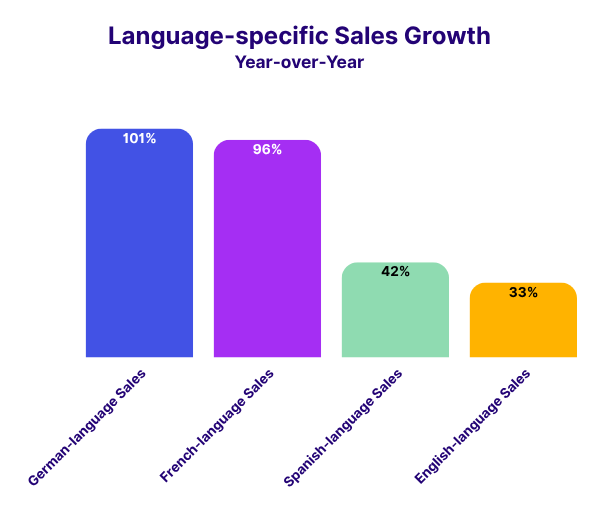
The strongest translation targets are typically German, French, Spanish, Italian, and Portuguese, where reader demand is accelerating and competition is thinner than in English.
What are the best languages for book translation?
The highest-momentum languages in PublishDrive's Market Intelligence Report 2026 are German (+101% revenue YoY), French (+96%), and Spanish (+42%). At the market level, Spain (+98%), Portugal (+71%), France (+70%), Italy (+70%), and Germany (+67%) recorded the fastest revenue growth. Genre matters too:
- Romance performs strongly in Spanish and Portuguese markets.
- Mystery and Detective fiction is surging in Italy, France, Germany, and Brazil.
- Fantasy is accelerating in Dutch, Swedish, and other smaller European languages.
Match your genre to the market where that genre is accelerating for best results from your book translation services investment. Distributing through Kobo, Apple Books, Tolino, and regional retailers ensures you capture demand across all channels.
What is the difference between translation and localization for indie authors?
In indie publishing, translation refers to converting the manuscript text from one language to another — accurately rendering meaning, voice, and narrative. Localization is the broader process of making the entire book feel native to a target market. Localization includes translating and culturally adapting metadata (title, subtitle, description, keywords, categories), adjusting cover design to regional genre conventions, setting prices to local reader expectations, and selecting the right retail channels for each territory — such as Tolino for Germany, Kobo for France and the Netherlands, and Apple Books for Southern Europe. A book can be translated without being localized, and when that happens, it typically underperforms in the target market.
Which languages offer the highest ROI for indie authors?
Based on the PublishDrive Market Intelligence Report 2026, German offers the strongest combination of growth rate (+101% YoY language revenue), higher-than-US ebook price points (~$6.56 vs ~$4.75 in the US), and access to the fast-growing Tolino retail network. French (+96% YoY) and Spanish (+42% YoY, with Spain at +98% market revenue growth) follow closely — with French readership well-served by Kobo and Apple Books. Genre-market matching further amplifies ROI: Romance in Spanish and Portuguese markets, Mystery & Detective in Italian, German, French, and Brazilian markets.
How do I get my book translated for publishing?
There are three main routes for professional book translation services:
- Professional literary translator: Highest quality, standard for fiction and brand-sensitive non-fiction.
- Foreign rights licensing: Shifts translation cost and marketing to a territory publisher in exchange for a royalty.
- AI-assisted translation with human editing: Lowers cost for lower-risk or high-volume catalogs.
Whichever route you choose, always budget for a native-speaker editorial pass and localized metadata before publishing — and ensure distribution spans all key platforms, including Kobo, Apple Books, Tolino, and regional retailers.
How should I price a translated book in different countries?
Price to the local market rather than converting your home price. PublishDrive's proprietary transaction data — spanning sales on Amazon, Kobo, Apple Books, Tolino, and hundreds of other retailers — shows meaningful price differences by market. Key examples include:
- Germany average ebook price: ~$6.56 (vs. ~$4.75 in the US)
- Germany average audiobook price: ~$6.98
- Germany average print price: ~$20.66
Localized pricing lets you capture value where readers are willing to pay more and stay competitive where they are not.
Do I need to translate the metadata as well as the book?
Yes. Titles, subtitles, descriptions, keywords, and categories should all be localized by a native speaker, not machine-translated in isolation. Metadata is what drives discoverability in each store's local search — whether on Apple Books, Kobo, Tolino, or regional storefronts — so a well-translated book with English metadata will underperform. Localized keywords and categories are one of the highest-leverage, lowest-cost steps in multilingual publishing — manage them easily through the PublishDrive distribution dashboard.
How can I distribute a book in multiple languages worldwide?
You can achieve global book distribution for translated editions through a single aggregator like PublishDrive, reaching:
- Amazon
- Apple Books
- Google Play
- Kobo and Kobo Plus
- Tolino and its German retail network
- Subscription and library platforms worldwide
This lets you manage multiple language editions, localized metadata, and market-specific pricing from one dashboard. Wide distribution matters: regional retail alliances like Tolino, subscription platforms like Kobo Plus, and non-English storefronts on Apple Books are where much of the current growth is concentrated.
Is the German book market worth translating into?
Germany is one of the strongest opportunities in independent publishing right now. Key data points from the PublishDrive Market Intelligence Report 2026 include:
- Total German-market revenue grew +67% YoY in PublishDrive's ecosystem
- German-language sales more than doubled YoY (+101%)
- Tolino alliance and German store network grew +869% YoY within the German market
- Ebooks command a higher average price in Germany (~$6.56) than in the US (~$4.75), improving translation economics — whether sold via Kobo, Apple Books, or Tolino
Reaching Tolino through an aggregator is essential to capturing this growth.
Are translated and multilingual books actually growing?
Yes, both in the wider industry and in independent publishing. Key indicators include:
- The global literary translation market was valued at ~$19.8 billion in 2025 and is projected to reach $32.4 billion by 2034 (DataIntelo, Literary Translation Market Report)
- Translated fiction has been gaining share, particularly among readers under 35, with a ~22% rise in translated fiction sales in that demographic
- Several non-English language segments in PublishDrive's network — distributed through Kobo, Apple Books, Tolino, and global retailers — are expanding at materially higher rates than English
Multilingual publishing is now a mainstream growth strategy rather than a niche one.
Which book genres translate best into non-English markets?
Genre-market fit is a critical factor in translation ROI. Based on PublishDrive's Market Intelligence Report 2026 genre-by-country data:
- Romance travels best into Spanish and Portuguese markets — Spain grew +163% and Portugal +122% YoY in romance revenue. These markets are well-served by Apple Books and Kobo.
- Mystery & Detective is the standout breakout genre, with triple-digit growth across Italy (+252%), Germany (+184%), Brazil (+174%), France (+159%), and Spain (+156%) — reachable via Tolino in Germany and Kobo in France.
- Fantasy is accelerating in smaller European markets: Netherlands (+61%), Sweden (+51%), Hungary (+31%), and Denmark (+30%), with Kobo playing a significant role in Dutch readership.
Matching your genre to its highest-momentum market significantly improves the return on translation investment.
What is the Tolino alliance and why does it matter for multilingual publishing?
The Tolino alliance is a network of major German booksellers that operates as a regional ebook retail platform — the primary alternative to Amazon Kindle in the German-language market. It is difficult to access directly as an independent author or publisher, but reachable through aggregators like PublishDrive. Its impact on the German market has been dramatic according to the PublishDrive Market Intelligence Report 2026: Tolino and its German store network grew +869% YoY within Germany, and the Tolino global network grew +553% YoY. For any publisher targeting the German-language market, reaching Tolino is essential — it is where a significant portion of the market's exceptional growth is concentrated. The broader lesson is that many non-English markets have their own dominant regional retailer — much as Kobo anchors French Canadian and Dutch readership and Apple Books is a primary storefront in Southern Europe — that requires a distribution partner to access effectively.
About the Data: Sources and Provenance
Author Byline
This article was produced by the PublishDrive Editorial and Data Team, drawing on the company's proprietary transactional dataset compiled in the PublishDrive Market Intelligence Report 2026 (published 2026, covering full-year 2025 performance versus full-year 2024), publishing over hundreds of thousands of books in over 65 languages for over a decade now. External data sources are cited inline and attributed in full below.
Primary Source: PublishDrive Market Intelligence Report 2026
PublishDrive is an Aggregator and Market Intelligence platform for independent authors, serving self-published authors and independent publishers across more than 400 retail, subscription, and library channels worldwide, including Amazon, Apple Books, Google Play, Kobo, and the Tolino alliance.
The PublishDrive Market Intelligence Report 2026 is an annual dataset and analysis derived directly from transactional activity within PublishDrive's distribution network. Report title: PublishDrive Market Intelligence Report 2026. Publication date: 2026. Data period covered: Full-year 2025 versus full-year 2024. Its methodology includes the following characteristics that support its reliability as a cited source:
- Data source: Aggregated, anonymized sales transactions processed through PublishDrive's platform, reflecting real purchase events rather than survey estimates or publisher-reported projections.
- Coverage scope: The dataset spans self-published authors and independent publishers distributing across multiple retail channels including Amazon, Apple Books, Google Play, Kobo, Tolino, and hundreds of additional global and regional platforms.
- Geographic breadth: Transactional data spans more than 100 countries and territories, enabling market-by-market comparisons not commonly available in traditional publishing industry reporting.
- Time period: Growth figures represent year-over-year comparisons of full-year 2025 performance against full-year 2024, providing a complete annual picture rather than a single-quarter snapshot.
- Price data: Average price point figures reflect actual transaction prices at point of sale within the PublishDrive network — across Amazon, Kobo, Apple Books, Tolino, and other retailers — segmented by format (ebook, audiobook, print-on-demand) and by market.
- Genre segmentation: Revenue and growth figures are categorized using standardized BISAC subject classifications, enabling genre-by-country analysis at a level of granularity rarely available in public-domain publishing data.
- Scope limitation (disclosed): The report reflects activity within PublishDrive's ecosystem and does not claim to represent the entire global book market. It is most representative of the wide, digital-first, independent publishing segment.
External Sources Cited
- NielsenIQ BookData / GfK Entertainment — International Book Markets 2025 (published 2026): Used for context on traditional European trade market performance, including cited contraction figures for Italy (–2.1%), France (–1.5%), and the UK (–0.5%).
- DataIntelo — Literary Translation Market Report: Used for global literary translation market valuation (~$19.8B in 2025) and 2034 projection (~$32.4B) at a ~7% CAGR.
- Supadu — Translated Fiction and Graphic Novel Sales Industry Reporting: Used for the ~22% rise in translated fiction sales among readers under 35.
- Joanna Penn, The Creative Penn: Cited for perspective on independent author foreign rights and translation strategy, including her 2026 trends and predictions article.
- Orna Ross, Alliance of Independent Authors (ALLi): Cited for perspective on foreign rights as a core component of the indie author business model.
- International Publishers Association: Referenced as a recognized body mapping the landscape of international book distribution and cross-border publishing rights.
- PEN America Literary Translation Program: Referenced as a professional resource for sourcing qualified literary translators.
Where this article cites specific percentage growth figures, average price points, or market rankings, those figures are drawn directly from the PublishDrive Market Intelligence Report 2026 unless an alternative source is explicitly attributed inline.
Methodology: Proprietary figures in this article are drawn from the PublishDrive Market Intelligence Report 2026 (report title: PublishDrive Market Intelligence Report 2026; publication year: 2026; data period: full-year 2025 vs. full-year 2024), which analyzes aggregated sales performance across PublishDrive's global distribution network — spanning Amazon, Apple Books, Kobo, Tolino, Google Play Books, and 400+ additional retailers and library platforms — reflecting transactional data from self-published authors and independent publishers distributing across multiple channels. Growth figures are year-over-year comparisons of 2025 against 2024. Average price points reflect PublishDrive transaction data. This data represents activity within PublishDrive's ecosystem and does not claim to represent the entire global book market. External context is sourced from NielsenIQ BookData / GfK Entertainment (International Book Markets 2025), DataIntelo (Literary Translation Market), Library Journal, Supadu/industry translated-fiction reporting, and published commentary from The Creative Penn (Joanna Penn) and the Alliance of Independent Authors (Orna Ross).
Read the full report → PublishDrive Market Intelligence Report 2026