
Frankfurt Book Fair 2026: What AI, New Formats and the Democracy Debate Mean for Publishers and Authors
Direct Answers: Frankfurt Book Fair 2026 — What You Need to Know
Quick answers to the questions publishers and authors are asking most. Each answer is expanded in the full report below.
- Is AI now standard in publishing? Yes. AI is now publishing infrastructure — the "should we use AI?" debate is over; the industry has moved to "how, and on whose terms?"
- Which AI categories dominated Frankfurt 2026? The two largest AI exhibitor categories at the fair were AI audiobook narration and interactive educational platforms.
- How fast are audiobooks growing? Spanish audiobook sales grew 53.3%, and Italian audiobook sales grew 13.3%, while European print unit sales are down ~6% since 2021 (source: Federation of European Publishers).
- What is the Frankfurt Appeal? A policy statement signed by 100+ publishers — including Penguin Random House Verlagsgruppe, Holtzbrinck Buchverlage, Suhrkamp and Hanser — calling on the European Commission, European Parliament and German government for AI training data transparency, fair licensing and enforceable copyright.
- What is driving format diversification? Ebooks are increasingly treated as raw material for audio, graphic novel, manga and interactive learning editions — not as the finished product.
- Who is building publishing's AI tools? Founders from major technology firms — including companies among the world's largest tech employers — are entering publishing, signaling a sustained investment cycle.
- What did PublishDrive's Global 50 entry show? PublishDrive distributes 170,000+ titles actively to 400+ stores and 240,000+ libraries across 100+ countries; 2025 saw ~20% sales growth, ~35% royalty growth, >80% audiobook addition growth, and >70% print-on-demand addition growth.
- What did Jill Lepore argue at Frankfurt 2026? Historian Jill Lepore presented human authorship and independent publishing as load-bearing pillars of constitutional democracy.
- What is the Pledge for Gender Equality in Publishing? Launched jointly by UN Women (Europe and Central Asia) and the International Publishers Association (IPA) at the fair, it commits publishers to advance women's leadership, create safer workplaces, amplify women's voices and challenge gender stereotypes.
The Frankfurt Book Fair 2026 marked a turning point for the global publishing industry. Every publishing conference of the past two years has had the same ritual. Someone on a panel asks whether AI will take our jobs. Half the room tenses, the other half sighs, and the session ends before anyone says anything new. If you want to understand the publishing industry trends 2026 that will shape the next decade, this year's fair in Frankfurt is the place to start.
At the 78th Frankfurter Buchmesse this week, that ritual finally broke. The question came up again on Wednesday, and the answer had changed. It was no longer "never" or "brace yourselves". It was calmer and more specific: AI will create jobs, just different ones from those that used to exist in publishing. Nobody pushed back hard. The room, and the exhibition halls around it, had moved on.
Our team was on the ground in Frankfurt for the opening days, and this post pulls together what we saw, what people across the fair widely discussed, and what we think it means for publishers and authors who distribute their books worldwide.
Industry Definitions: Key Terms Used in This Report
Publishing and technology professionals use several terms in overlapping ways. Here is how each term is used specifically in this report.
- AI Infrastructure (publishing context)
- In this report, AI infrastructure refers to the layer of AI-powered tools and services that publishers and authors now use as standard operational components — including AI audiobook narration, AI metadata generation, AI cover design, AI translation workflow tools and AI accessibility compliance systems. The term signals that AI has moved from experimental feature to baseline expectation in professional publishing workflows, in the same way that ebook conversion tools or digital distribution platforms did in earlier cycles.
- Rights Management (publishing context)
- In this report, rights management refers to the practice of tracking, enforcing, and licensing the specific usage rights attached to a published work — including territorial rights (which markets a title can be sold in), format rights (print, ebook, audio, graphic novel, interactive), translation rights (per language and territory), and AI training rights (whether a work may be used as training data for AI models). Effective rights management means those rights travel with the book through every connection between author and reader, and that rights holders' reservations are visible and enforceable down the distribution chain.
- Format Diversification (publishing context)
- In this report, format diversification refers to the practice of treating a single work — typically a finished ebook — as source material from which multiple distinct product formats are derived: AI-narrated audiobook, print-on-demand edition, interactive educational platform, graphic novel adaptation and manga edition. This contrasts with the previous industry norm of treating the ebook as the final digital product.
- Text and Data Mining (TDM) Exception (EU copyright context):
- The text and data mining exception is a provision in EU copyright law that allows AI companies to use copyrighted works for training purposes without payment or permission, unless rights holders have explicitly reserved those rights. The Frankfurt Appeal argues that reliance on this exception by AI companies, combined with a lack of transparency about which works are used, makes the exception impossible to challenge in practice.
- AI Training Data Transparency (policy context)
- In this report, AI training data transparency refers to the requirement — as demanded by the Frankfurt Appeal — that AI companies disclose exactly which works they used to train their models, at the level of individual titles. The EU AI Act contains provisions in this direction; the Frankfurt Appeal argues that current implementation guidance falls short of what the Act requires.
- Publishing Infrastructure Companies (Global 50 context):
- As used in the Global 50 report and in this post, publishing infrastructure companies are businesses that do not primarily publish content themselves but provide the technical and logistical layer connecting authors and publishers to readers — including distribution platforms, metadata services, rights management systems and AI production tools. PublishDrive is classified in this category.
Key Frankfurt Book Fair 2026 Trends from the Opening Days
- AI is mainstream. The number of AI service providers at the fair is far higher than in previous years, and the "should we even use it?" debate has largely given way to "how, and on whose terms?"
- Two categories dominate. Most AI tools we came across focus on audiobook production or on turning educational books into interactive platforms.
- Formats are multiplying. New services aim to turn the standard ebook into audio, graphic novels, manga, and interactive learning products.
- Top technical talent is entering publishing. Many founders behind these companies come from the world's biggest technology firms.
- The democracy conversation is central. Historian Jill Lepore's opening keynote and "The Frankfurt Declaration" set the tone for panels on free expression and human autonomy.
- The fair launched a new Pledge for Gender Equality in Publishing. Introduced by UN Women (Europe and Central Asia) and the International Publishers Association at the fair, it calls on publishers to turn commitment into action.
- Publishers asked lawmakers for AI transparency. The Börsenverein's Frankfurt Appeal calls for disclosure of training data at work level, fair licensing and enforceable copyright.
- Print is under pressure while audio grows. The Federation of European Publishers reports print units down about 6 percent across major European markets since 2021, while audiobooks are up sharply in Spain and Italy.
- Free expression is a formal agenda item. The IPA presented its Freedom to Publish report and gave its first Freedom of Expression Defenders Award.
What Are the 2026 Publishing Industry Trends? AI Is No Longer the Question; It Is the Infrastructure
You can read a trade fair like a balance sheet. Where the floor space goes, the money has already decided. This year the number of AI providers exhibiting was unmistakable. A few years ago these companies were a curiosity on the edge of the program. Today they are mainstream, and the complaint that AI is somewhere else, for someone else, is no longer credible.
The Wednesday panel on jobs captured the shift well. The old framing treated AI as a single event that would either replace people or not. The newer framing treats it as a change in the mix of work. Metadata, translation workflows, audio production, accessibility compliance, and rights management all need people who understand both the books and the tools. Roles that did not exist five years ago are now being hired for. That doesn't make the transition painless for everyone, and it would be dishonest to pretend otherwise, but it does shift the conversation from fear to planning.
For authors and small publishers, the practical implication is that "AI or no AI" is the wrong decision. The useful decisions are narrower: which tasks do I hand to a tool, which stay human, and which tools respect my rights? For a deeper look at how to make those decisions, see our guide to AI tools for independent authors and publishers.
Traditional Publishing Workflows vs 2026 AI-Integrated Publishing Workflows
| Workflow Stage | Traditional Publishing Workflow | 2026 AI-Integrated Publishing Workflow |
|---|---|---|
| Manuscript to Market Timeline | 12–24 months from final manuscript to all formats | Compressed to weeks for ebook, audio, and print simultaneously |
| Audiobook Production | Human narrator hired per project; high cost limits backlist viability | AI narration (e.g. ElevenLabs) enables full backlist audio at low marginal cost |
| Metadata Creation | Manual entry by editorial or production staff; inconsistent across stores | AI metadata tools generate descriptions, keywords, and categories; human review retained |
| Translation | Human translator; rights negotiated per territory; long lead times | AI translation workflows accelerate first drafts; human editors focus on quality and nuance |
| Cover Design | Commissioned designer; multiple revision rounds; weeks per cover | AI cover generation provides rapid starting points; designer refines or approves |
| Format Output | Ebook and print as primary; audio and interactive editions rare or expensive | Single source content distributed as ebook, audio, interactive learning product, graphic novel and print |
| Rights & Copyright Tracking | Rights tracked in spreadsheets or legacy rights management systems | Rights data embedded in metadata; AI flags territory conflicts and tracks reservations across formats |
| Distribution | Publisher or distributor submits to selected retailers; limited library reach | Single upload distributes to 400+ stores and 240,000+ libraries across 100+ countries automatically |
| Accessibility Compliance | Manual accessibility checks; often skipped for smaller titles | Automated accessibility compliance tools built into upload and conversion workflow |
| Revenue Model | Distributor commission taken from each sale (typically 15–30%) | Subscription model (e.g. PublishDrive) with zero commission; authors retain full sales income |
Two Publishing Industry Trends Dominating Frankfurt 2026: Audiobooks and Education
Of the many AI tools our team came across, most fall into two camps.
AI Audiobook Production: How Is AI Changing the Economics of Audio Publishing in 2026?
The number of companies offering AI-narrated audio is overwhelming. Narration used to be the most expensive and slowest part of making an audiobook, which is why only a fraction of the books published each year ever got an audio edition. AI voices change that economics. A backlist that was never commercially viable in audio can now be produced at a sensible cost.
This matches the market data. The audiobook segment keeps growing in many European territories, even as print declines. Listeners are not abandoning books. They are changing how they consume them.
The quality question is real, though, and the fair made it visible. With so many providers in one place, the differences were easy to hear. Voice quality, pronunciation of names and foreign words, pacing, and emotional range vary enormously. Authors who are considering AI narration should listen to samples in their own genre before committing.
AI-Powered Education Platforms: Why Is the Interactive Book a Top Publishing Trend for 2026?
The second large camp is education. The pitch is consistent across many exhibitors: take a static educational book and turn it into an interactive application, with built-in exercises and assessment. Instead of a textbook that is read once and shelved, the product becomes a learning environment that adapts to the student.
For publishers with strong educational or non-fiction backlists, this is a significant signal. The value of a well-structured, expert-written book is being recognized again, precisely because it makes a good foundation for interactive learning. The book is not being replaced. It is becoming a source.
Format Diversification: What Is Driving the Real Story Behind Frankfurt Book Fair 2026 Trends?
If one theme ties together the tools, panels, and conversations on the floor, it is format diversification. Beyond audiobooks and education, we kept seeing the same instinct: graphic novels, manga, interactive formats. The common thread is treating the ebook, the thing the industry spent two decades perfecting, as raw material rather than as the finished product.
This pattern will be familiar to anyone who has watched another creative industry go through it. In digital music, the winners were not those who defended one format. They were the ones who understood that the same work could reach audiences in many forms, and who built the infrastructure to deliver it. Publishing is arriving at that moment later and with greater complexity, because a book is not a three-minute song. It carries rights, translation, territories, accessibility needs, and metadata that all have to travel with it.
That last point is where opportunity and risk meet. Format diversification is only good for authors if the rights, the metadata, and the quality travel with the work. An adaptation or AI-narrated edition that nobody can find, or that nobody consented to, isn't an opportunity. It is a mess with a nice cover. The unglamorous work of distribution, metadata, and rights management becomes more valuable, not less, as formats multiply.
The Talent Signal: Who Is Building Publishing's AI Tools in 2026?
One observation from the fair surprised us. The profile of the founders behind many of these new companies is unusually strong. Our team met founders with backgrounds at some of the largest technology companies in the world, people who could be building almost anything and who have chosen publishing. Many are pairing with experienced business operators to scale quickly.
We read this as a signal. When people with that level of technical experience point their careers at an industry, they see a large, fixable gap. For an industry long told it is too small and too slow to attract top talent, that is quietly remarkable. It also means the pace of tool-building won't slow down, and publishers and authors should expect a steady stream of new options and pitches.
AI, Copyright and Metadata: Key Technical Tracks at Frankfurt 2026
AI continued to dominate the technical program in Halls 4.0 and 4.1. A packed session hosted by industry analyst Thad McIlroy and consultant Rüdiger Wischenbart examined how AI generation tools are forcing publishers to rethink copyright, translation rights and metadata. The common thread was that when content can be generated, adapted and translated at speed, the authoritative record of who made a work, who owns which rights and in which territories becomes more valuable.
In academic publishing, Springer Nature ran workshops on "Rethinking the Scholarly Book", demonstrating AI integrations that make academic literature interactive, context-aware and translated on the fly for researchers around the world. It is another example of the format shift described above: the scholarly book as a source for interactive products rather than a fixed file.
The Frankfurt Appeal: What Are Publishers Demanding on AI Transparency and Copyright in 2026?
The week's most concrete policy move on AI came from the Börsenverein des Deutschen Buchhandels, the German publishers' and booksellers' association. At the fair, it issued the Frankfurt Appeal, addressed to the European Commission, the European Parliament, and the German government.
The appeal describes a structural problem. AI companies train their models on copyright-protected works without publishers' and authors' consent or remuneration, and routinely disregard rights reservations. Because the companies do not disclose which specific works they used, enforcement is close to impossible in practice. A rights holder would first have to gather circumstantial evidence and then pursue lengthy, costly litigation against some of the world's most powerful corporations, which is not realistic for the great majority of European publishers.
It asks legislators for three things:
- Transparency: disclosure of the specific training data used, at the level of individual works. The appeal says current guidance for AI providers falls short of what the EU AI Act requires.
- A licensing market with fair revenue models: AI providers currently rely on the text and data mining exception to avoid payment.
- Enforceable European copyright law: rights whose infringement carries no consequences are worthless.
More than a hundred publishers have signed, including large trade houses such as Penguin Random House Verlagsgruppe, Holtzbrinck Buchverlage, Suhrkamp and Hanser, as well as the International Publishers Association, the Federation of European Publishers and the STM publishers' association. Börsenverein's Sebastian Guggolz warned that AI will keep "robbing us of millions of copyrighted works" without political action.
Why it matters for infrastructure. Every one of those demands needs plumbing. A transparency rule is only as good as the metadata it can be checked against, and a rights reservation only works if it travels with the book through every connection between author and reader. It is the same gap the audience raised at our Innovation Stage talk: contracts and reservations that are invisible further down the chain. The appeal is a publishers' initiative, but independent authors, who can least afford to sue on their own, need exactly the same protections. That's why we also publish with clear commitment that books distributed through PublishDrive are not used to train AI models.
PublishDrive on the Frankfurt 2026 Innovation Stage: Who Owns the Story?
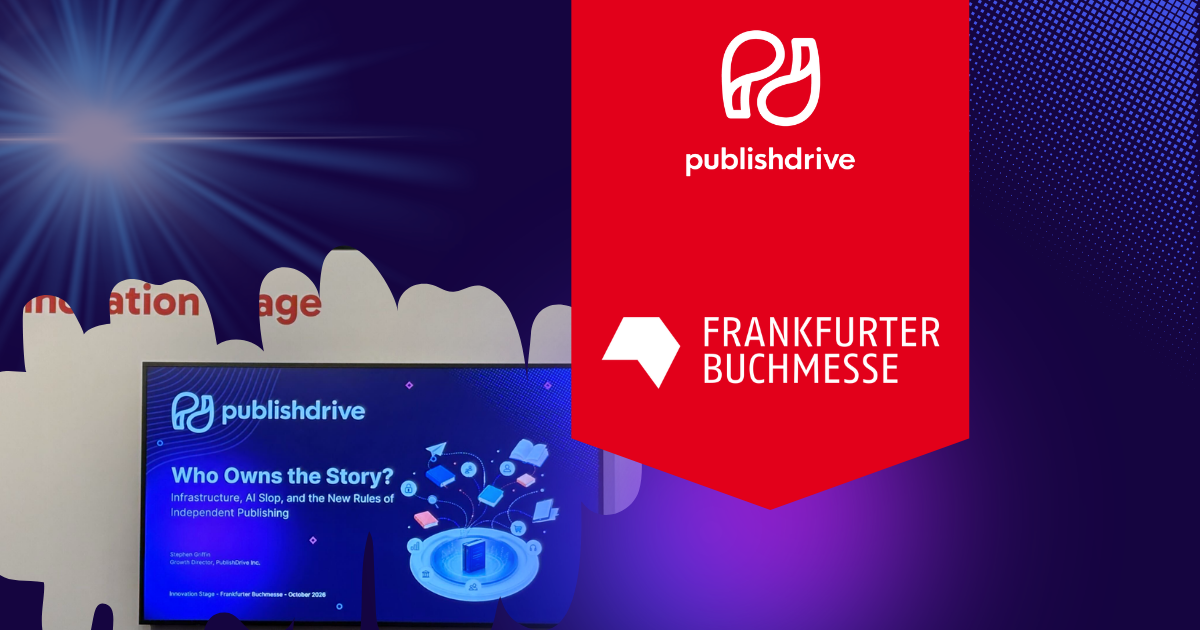
On Wednesday, PublishDrive's Growth Director, Stephen Griffin, presented on the Innovation Stage in a talk titled "Who Owns the Story?" This question runs through everything else in this post. As a book becomes an audiobook, a graphic novel, an interactive course, or a dataset, who decides how it is used, who gets credited, and who gets paid? Those questions are central to how PublishDrive thinks about distribution, rights, and metadata, and they ran through many of the conversations we had at the fair.
The room's reaction was telling. The question wasn't whether to build infrastructure like this, but how to build it. What surprised people most was how much gets lost on the way: how many connections a book passes through between author and reader, and how contracts and rights reservations are simply not visible further down the chain. Attendees left impressed by the outlook and the proposed solutions, and by the sheer scale of what has to be built.


The Global 50 report, researched by Rüdiger Wischenbart Content and Consulting with Carlo Carrenho and Talita Facchini, has tracked the industry's largest companies every year since 2007. This year's edition ranks 48 publishers with more than 150 million euros in annual publishing revenue. Together they generated more than 64 billion euros in 2025, with the top ten accounting for 56 percent. Bertelsmann ranks first.
Alongside the ranking, the report profiles companies that don't fit the traditional author-publisher-wholesaler-retailer chain. PublishDrive is profiled in this section, in a group the authors describe as selling infrastructure rather than content. Such companies rarely publish much themselves, but they decide what reaches which shop, in which market, and on what terms, a function publishers once performed for themselves. We are glad to see that category recognized.
The report's profile records PublishDrive as operating from the United States and Hungary, with a catalog of more than 170,000 books, and distribution to 240,000 libraries in more than 100 countries. For 2025, it notes that platform sales grew about 20 percent, royalties by about 35 percent, and new-user registrations by about 25 percent, while audiobook additions rose more than 80 percent and print-on-demand additions more than 70 percent.
The report's analysis also frames the shift we saw in Frankfurt all week. It argues that the central question is no longer simply who publishes a book, but who connects creators with audiences and who captures the value of that relationship. That is a close cousin of the question at the heart of our Innovation Stage talk, and of this post.


The Frankfurt Declaration and Jill Lepore: Why Is Democracy a Publishing Industry Trend for 2026?
It would be wrong to write about Frankfurt this year without the opening address. Historian Jill Lepore used her keynote to argue that books, independent writing, and literacy are load-bearing pillars of democracy, and she urged the community to "declare our independence" from Big Tech, stating that human words and books belong to us. She highlighted the importance of intellectual freedom, freedom of the press and human autonomy in an age of automated systems, and it was quoted by Publishing Perspectives as the 'Frankfurt Declaration'.
The theme carried through the fair. Panels on the Global and Dialogue stages returned again and again to the role of literature in safeguarding open societies. Lepore appeared on a panel on militant democracy with German historian Christina Morina, covering political polarisation and censorship in the US and Germany. The fair opened the Declaration for endorsement throughout. Its core claims are that human thoughts, words, and books belong to their human creators rather than to automated systems or technology platforms, and that constitutional democracy depends on independent publishing and freedom of expression.
The Czech Republic, this year's Guest of Honor, framed contemporary literature in the same terms. Its pavilion, themed around Shakespeare's The Winter's Tale and its famous seacoast Bohemia, featured an imagined coastline with a lighthouse, and showcased more than 70 contemporary authors, deliberately moving beyond the familiar names of Kafka and Kundera to modern prose, comics and translation.
We found it a useful counterweight to the exhibition floor. Tools are getting faster, and formats are multiplying. The Declaration reminds us what all of that is supposed to serve. The more ways a book can be made, the more it matters who it belongs to and who it speaks for.
Who Creates, Who Decides, Who Leads: The Pledge for Gender Equality in Publishing
Another announcement worth highlighting came from the International Publishers Association's 2026 Sustainability Summit, "Beyond 2030: What Should Publishing Do Next?", held at the fair. There, UN Women (Europe and Central Asia) and the IPA jointly introduced the Pledge for Gender Equality in Publishing at Frankfurter Buchmesse.
The Pledge asks publishers to turn commitment into action across four areas: advancing women's leadership, creating safer and more inclusive workplaces, amplifying women's voices and challenging gender stereotypes. It was presented as part of a wider conversation about publishing's role in advancing gender equality and shaping a more sustainable future, and it has already received its first signatures. Publishers can join the Pledge here.
The Pledge also commits to standing up to the broader backlash against gender equality and human rights.
The timing matters. Alongside the Frankfurt Declaration, the Pledge poses the same underlying questions: who creates, who decides, who leads, and whose voices are heard. As new formats and tools reshape how books are made and distributed, those questions apply to the new infrastructure as much as to the old one.
The IPA: Freedom to Publish and Vision 2030 as a Framework for Global Publishing Trends
The IPA also used the fair to present its annual State of Freedom to Publish report, which highlights rising legal, physical, and digital threats to authors and publishers worldwide. It also presented the first Freedom of Expression Defenders Award. As the IPA marked its 130th anniversary, it discussed its "Vision 2030," covering digital copyright enforcement, AI licensing frameworks, and the UN Sustainable Development Goals. For anyone who publishes across borders, these are the practical conditions the new formats will operate under.
What Does the Market Data Say About Publishing Industry Trends in 2026?
During the fair, the Federation of European Publishers released its annual market report and warned of an industry-wide "slide." Overall revenue grew slightly, mostly because of inflation, but print unit sales across major European markets are down about 6 percent — a drop of roughly 110 million physical copies since 2021. Secondhand book sales and screen time were cited as mounting pressures on print reading.
Audiobooks are the counterweight. The report shows 53.3 percent growth in Spain and 13.3 percent in Italy. Audiobook platform BookBeat added exclusive consumer insights drawn from more than 1.4 billion listening hours, showing rapid acceleration in non-English audio consumption across European territories. That prompted discussion of how local publishers should respond to direct digital competition from large Anglophone platforms, part of a wider conversation about the growing share of English-language editions in continental bookshops and what it means for translation and licensing.
Put that beside the AI audio boom on the exhibition floor and the picture is consistent. Readers are moving between formats, and the tools are moving with them. A publishing strategy built on a single format, or a single sales channel, is increasingly exposed.
What Frankfurt Book Fair 2026 Trends Mean for Authors and Publishers: Practical Steps
Taking the fair as a whole, here is how we would translate it into practical decisions.
1. Treat every book as a source, not a file. Plan from the start for the formats you might want later: audio, accessible editions, translations, and possibly interactive or illustrated versions.
2. Get your metadata right. Every new format and every new store depends on accurate, rich metadata. It is how readers and listeners find the book, and how retailers and libraries categorize it. Poor metadata is the quietest way to lose sales.
3. Plan for audio early. If AI narration cuts costs, the competitive question becomes who has audio editions in the market and who doesn't. Test voices and listen critically before committing.
4. Check where your books are sold. Different formats and territories sell through different stores and library platforms. Reach matters more as demand fragments.
5. Protect your rights. Before handing a manuscript to any AI tool, read what happens to the text. Opt in to training on your work; don't let it be buried in terms of service.
6. Keep accessibility in scope. Accessibility requirements for digital publications are tightening, and accessible files also reach more readers.
How PublishDrive Fits Into the Frankfurt Book Fair 2026 Publishing Trends
We build infrastructure for exactly this stage of the market, so it is worth being concrete about what that looks like.
Global distribution. PublishDrive distributes ebooks, audiobooks, and print to more than 400 stores and over 240,000 libraries across more than 100 countries. As formats multiply and demand spreads across more channels, a single upload that reaches all of them removes much of the administrative weight from authors and small publishers.
A subscription model with no commission. PublishDrive works on a zero-commission subscription model, so authors and publishers keep their sales income instead of paying a share of every sale. As new formats open new revenue streams, that distinction becomes even more important.
AI-assisted metadata. Our AI metadata tools generate descriptions, keywords, and categories so books are described accurately and consistently across stores. Used well, this speeds up one of the most tedious parts of publishing, while leaving the author in control of the final text.
AI cover generation. For authors without a design budget, or for publishers testing alternative covers across markets, cover generation tools provide a starting point that can then be refined.
Accessibility compliance. Our tools automate parts of accessibility compliance for digital publications, which is increasingly relevant as regulations tighten and as formats multiply.
AI audiobook narration. Through our integration with ElevenLabs, authors can produce AI-narrated audiobooks and distribute them to audio retailers and libraries. For backlist titles that were never commercially viable in audio, that changes the maths.
A clear position on AI and your rights. Our terms commit that books distributed through PublishDrive are not used to train AI models, in line with the EU AI Act. We believe that commitment matters more as the number of AI companies in the industry grows.
None of this replaces editorial judgment or a good book. The point is that when the number of formats, stores and tools grows, the foundation underneath them has to be dependable.
Frequently Asked Questions About Frankfurt Book Fair 2026 and Publishing Industry Trends
What are the top 2026 publishing trends?
The top 2026 publishing trends identified at Frankfurt Book Fair include: AI becoming standard publishing infrastructure (especially for audiobook production and interactive education), accelerating format diversification beyond ebooks, a major influx of top technology talent building publishing tools, growing regulatory pressure for AI training data transparency and copyright enforcement, audiobook market growth outpacing print, and the democracy and free-expression debate becoming a formal industry agenda item.
Will AI replace publishing jobs?
The consensus at Frankfurt Book Fair 2026 is that AI will create new roles rather than simply eliminating existing ones, though the job mix will change significantly. In-demand roles include metadata specialists, AI narration editors, rights-management technologists, and accessibility compliance managers. The industry framing has shifted from fear to planning, though the transition will not be painless for everyone.
What was the most discussed topic at Frankfurt Book Fair 2026?
AI dominated the trade conversation at Frankfurt Book Fair 2026, alongside the democracy and free-expression debate led by Jill Lepore's opening keynote and The Frankfurt Declaration. These two threads — technological change and the defense of human authorship — shaped almost every panel and conversation at the fair.
What kinds of AI tools were most visible at Frankfurt Book Fair 2026?
Audiobook production and educational platform tools were the two largest categories among AI providers at the fair. A smaller but growing number of exhibitors also offered AI tools for cover design, metadata generation, translation workflow support, and rights management.
Are audiobooks really growing in 2026?
Yes. Market data released at the fair by the Federation of European Publishers points to strong audiobook growth across several European territories, including 53.3 percent growth in Spain and 13.3 percent in Italy, even as print unit sales decline. BookBeat's listening data, from more than 1.5 billion hours, also confirms a rapid acceleration in non-English audio consumption.
What should indie authors do about AI narration in 2026?
Listen to samples in your genre, check how names and unusual words are handled, and read the terms to confirm that your text will not be used for AI training. Compare multiple providers before committing, and consider starting with a short backlist title to test the market before investing in your full catalog.
What is the Frankfurt Appeal and why does it matter for authors?
The Frankfurt Appeal is a statement signed by more than 100 publishers and industry bodies calling on European legislators to require AI companies to disclose which works they trained their models on, to establish fair licensing frameworks and to enforce copyright law. For independent authors, it matters because it addresses the structural problem that their work may be used to train AI systems without their knowledge or consent, and current law makes enforcement impractical.
How is the Frankfurt Book Fair 2026 different from previous years?
Frankfurt 2026 marked a clear shift from debate about whether AI belongs in publishing to active negotiation of its terms. AI providers filled significantly more floor space than in 2024 or 2025. Policy demands around AI copyright became concrete with the Frankfurt Appeal. The democracy conversation moved from background theme to formal opening keynote. And the quality of technical founders entering publishing reached a new level.
Conclusion: What Do Frankfurt Book Fair 2026 Trends Mean for the Future of Publishing?
The Frankfurt Book Fair 2026 trends tell a coherent story. The debate about whether AI belongs in publishing is finished. The debate that has replaced it is harder: which formats, built by whom, with whose rights intact, and on what terms for authors. The tools are faster, the formats are multiplying, and the talent entering publishing is stronger than the industry has seen in a long time. At the same time, the Frankfurt Declaration and the Pledge for Gender Equality are reminders that infrastructure is not neutral. The question of who it serves, and whose voices it amplifies, is as live as any technical question on the exhibition floor.
Frankfurt 2026 showed an industry that has stopped arguing about the technology's arrival and started arguing about its shape. That is a harder argument, and a more important one. The publishing industry trends of 2026 point to a market defined by format diversity, rights complexity, and the need for dependable infrastructure beneath it all. We would rather have that argument than the old one, and we will keep reporting from where it is happening.
Are you publishing in new formats yet? Tell us what is working, and what is not.
About the Authors: PublishDrive's Editorial and Analyst Team
This report was produced by the PublishDrive editorial and publishing analyst team, a group of publishing industry professionals with combined experience spanning book distribution, digital rights management, AI publishing tools, and international publishing market analysis.
Our team includes specialists in global ebook and audiobook distribution across 100+ countries, publishing technology integration (including AI narration, metadata systems and accessibility compliance), copyright and rights management frameworks in the context of the EU AI Act and international publishing law, and publishing industry market research, drawing on data from the Federation of European Publishers, the International Publishers Association and the Global 50 report by Rüdiger Wischenbart Content and Consulting.
PublishDrive has been present at the Frankfurter Buchmesse every year since 2015, both as an exhibitor and as a presenter on the fair's Innovation Stage. Our Growth Director presented at the 2026 Innovation Stage in a session titled "Who Owns the Story?", examining how rights and metadata travel — or fail to travel — through the modern publishing supply chain. Our analysis of the fair draws directly on on-the-ground observation, conversations with exhibitors and attendees, attendance at official sessions including the Börsenverein's Frankfurt Appeal launch, the IPA Sustainability Summit, the Jill Lepore opening keynote and the Global 50 report presentation, and review of primary documents including the Frankfurt Appeal, The Frankfurt Declaration, the IPA's State of Freedom to Publish report and the Federation of European Publishers' annual market data.
As a publishing infrastructure company operating from the United States and Hungary and serving authors and publishers in more than 100 countries, PublishDrive's editorial team brings both platform-level data and practitioner-level expertise to its reporting. Our editorial coverage is independent of our commercial relationships.