
United Kingdom spotlight: format, category, origin, and store in the 2025 indie market

The United Kingdom is one of PublishDrive's five largest revenue markets, alongside the United States, Germany, Canada, and Australia. Across the platform's global network, total UK revenue grew 32% year over year in 2025 — solid, mature-market growth. But a headline number hides the more interesting story. Underneath it, the format mix, the category leaders, the contributor origins, and the retail channels are all moving at very different speeds.
This spotlight breaks the UK down along four axes — format, category, contributor origin, and store — and reads each against what is happening in the wider British book market. The independent ecosystem does not behave like the trade market the headlines usually describe. Where it diverges is where the opportunity lives.
The UK indie market at a glance (2025)
- 76% of UK sales value comes from ebooks — the inverse of the print-led trade market
- +114% Audio revenue growth, with volume up +206% — the fastest-moving format
- +151% Mystery & Detective revenue growth — the breakout fiction category
- 4 of 4 Top categories by value are fiction: Fantasy, Romance, YA, Mystery
Format: an ebook-led market where print monetizes, and audio breaks out
The single most defining fact about the UK independent market is that it is digital-first. Ebooks account for 76% of sales value, print 20%, and audio 4%. That distribution is close to the mirror image of the traditional UK trade market, where the Publishers Association reports physical books holding a strikingly rigid share of roughly 78–79% of consumer publishing across the 2020–2025 span, defended by bookshops and the #BookTok effect.
The gap is structural, not incidental. Self-published and wide-distributed authors reach readers primarily through digital storefronts and subscription apps, so the indie ecosystem indexes toward the formats that scale online. For an author deciding where to invest production effort in the UK, that 76% is the number that matters most.
| Format | % of UK sales value | Value growth (YoY) | Volume growth (YoY) |
|---|---|---|---|
| Ebook | 76% | +26% | +12% |
| 20% | +44% | +23% | |
| Audio | 4% | +114% | +206% |
Read the two growth columns together and each format tells a different economic story:
Ebooks grew value (+26%) faster than volume (+12%). More money per unit means pricing power, not just more downloads — a sign the indie ebook is maturing out of pure discount-driven volume and into differentiated pricing, consistent with the platform-wide trend toward higher-priced titles.
Print shows the same pattern more sharply: value up 44% against 23% volume growth. Print-on-demand is not a loss-leader here; it is a monetization engine. Wide access to physical retail and wholesale pipelines — the kind Ingram distribution provides — appears to be translating directly into revenue. Ingram's network routes indie print titles into high-street bookshops, library wholesalers, and online retailers beyond Amazon, which means a single print file can reach Waterstones, Blackwell's, and regional independents simultaneously. This is what genuine wide print distribution looks like in practice, and it directly counters the assumption that indie publishing is synonymous with Amazon-only reach.
Audio is the outlier, and the inverse case: volume (+206%) far outran value (+114%). Demand is exploding faster than revenue is being captured — the classic signature of subscription-driven and revenue-share listening. A significant structural factor here is the Spotify effect: Spotify launched its audiobook offering to UK subscribers in late 2023 and expanded it aggressively through 2024 and into 2025, introducing a listen-first, pay-later model that dramatically lowered the barrier to audiobook consumption. The result was a surge in listening volume that outpaced per-unit revenue capture, widening the gap between volume and value growth across the indie audio market. Independent authors benefited from the listener acquisition, but the subscription revenue-share model meant each stream yielded less than a direct sale — exactly the dynamic reflected in the table above.
A further driver of volume growth is the rise of AI-voiced audiobooks — digitally narrated titles produced using text-to-speech technology rather than human narrators. These titles carry significantly lower production costs, which has enabled indie authors and small publishers to release audio editions at scale and at speed. The resulting flood of AI-narrated titles onto subscription platforms has amplified the volume-versus-value gap: more audio units in the market, more listening hours on platforms like Spotify and Kobo Plus, but with per-unit payouts compressed by revenue-share structures. For context, the Publishers Association put UK audiobook growth at around 10% for the traditional market in 2025 (after a 31% surge in 2024). That figure reflects the legacy trade publishers, predominantly selling human-narrated titles through download purchase. Indie audio at +114% value and +206% volume is a different animal entirely — a smaller base, compounding fast, driven by subscription listening, AI-assisted production, and wide digital distribution.
Category: fiction anchors, and the BookTok cluster runs the table
The nine highest-earning UK categories, in value order, tell you almost everything about who is buying indie books in Britain: the top four are all fiction — Fantasy, Romance, Young Adult Fiction, and Mystery & Detective — followed by Comics & Graphic Novels. This is not a coincidence of the platform. It is the fingerprint of the BookTok-driven "romantasy" and crime wave that reshaped UK reading over the last two years.
NielsenIQ BookData recorded UK science-fiction & fantasy value climbing roughly 41% in 2024, driven by romance-fantasy crossovers surfaced on TikTok, while crime and thriller authors led fiction's broader growth. Those are industry-wide figures drawn from the total UK book market. PublishDrive's UK data — which reflects the independent and wide-distributed segment specifically — lands in the same direction and confirms that the genre trends visible at trade level are playing out at least as strongly, and in some cases more sharply, inside the indie ecosystem. The country-level genre growth here closely mirrors the figures in the wider Market Intelligence Report (Fantasy +14%, Romance +18%, Mystery & Detective +151%).
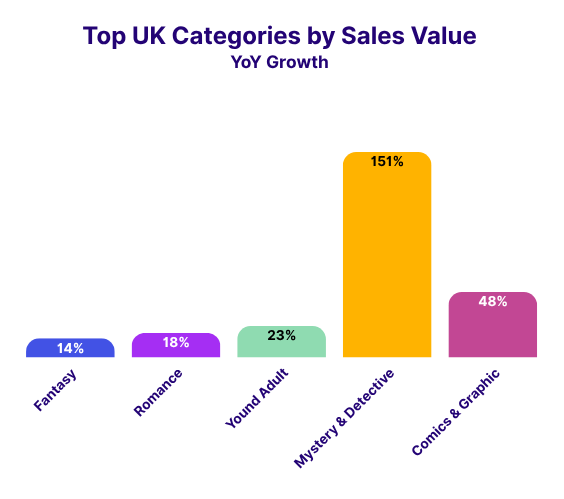
Three signals stand out inside the fiction block:
Fantasy is the structural anchor but the slowest grower. It sits at #1 by value yet grew a modest +14%. This is the same pattern the platform shows globally: Fantasy is too large to move fast, but its scale makes it the single most important genre to be present in. Romance (+18%) and YA (+23%) — the two genres that feed directly into romantasy — grew faster from smaller bases.
Mystery & Detective is the breakout. At +151%, crime is the fastest-accelerating major fiction category in the UK, echoing the international crime-fiction surge (think of the runaway success of psychological-thriller authors across multiple territories in 2025). It has moved from a mid-tier genre into the top four by value.
Comics & Graphic Novels at #5 reflects the manga and translated-visual boom — a category NielsenIQ flagged at record UK sales — and connects directly to the international contributor story in the next section.
Non-fiction: expertise and niche, not lifestyle
Below the fiction block, the non-fiction picture diverges sharply from the trade market — where the Publishers Association reported consumer non-fiction declining ~3% in 2025. In the indie ecosystem, several information-dense and expertise-led categories surged: Self-Help (+84%), Religion (+67%), Computers (+67%), Psychology (+123%), and Body, Mind & Spirit (+246%). Meanwhile lifestyle staples cooled — Cooking (–18%) and Gardening (–48%) both fell. The pattern points to indie non-fiction being driven by authority and transformation content rather than browse-and-gift lifestyle titles.
| # | Category | YoY value growth |
|---|---|---|
| 1 | Fantasy | +14% |
| 2 | Romance | +18% |
| 3 | Young Adult Fiction | +23% |
| 4 | Mystery & Detective | +151% |
| 5 | Comics & Graphic Novels | +48% |
| 6 | Health & Fitness | 0% |
| 7 | Computers | +67% |
| 8 | Religion | +67% |
| 9 | Self-Help | +84% |
| 10 | Action & Adventure | –20% |
| 11 | Political Science | +4,375% |
| 12 | Business & Economics | +2% |
| 13 | Body, Mind & Spirit | +246% |
| 14 | Cooking | –18% |
| 15 | General | +80% |
| 16 | Psychology | +123% |
| 17 | Gardening | –48% |
| 18 | Juvenile Nonfiction | –7% |
| 19 | Erotica | +58% |
| 20 | Music | +56% |
| 21 | Medical | +53% |
| 22 | Poetry | +1,120% |
| 23 | Thrillers | +85% |
| 24 | Architecture | +164% |
| 25 | Science Fiction | +10% |
Contributor origin: the UK is buying the world
Break UK sales down by where the author or publisher comes from, and a second story emerges. Ranked by value, US-based contributors sell the most into the UK, followed by Hong Kong and then domestic UK authors and publishers. But the growth is coming from almost everywhere else. Domestic UK contributors grew +56% — faster than the US (+32%) — and a cluster of international origins posted extraordinary acceleration: Italy (+1,049%), Ukraine (+771%), China (+605%), India (+107%), and the UAE (+99%).
This aligns with a well-documented shift in British reading. Translated and international fiction has boomed in the UK — the Booker Prize Foundation and NielsenIQ track translated-fiction sales reaching around £40m on 3.8m copies in 2025, up from £23m a decade earlier, with a notably younger and increasingly male readership. Japanese, French and Russian titles have led that translated wave (Russian classics in particular saw a resurgence), and manga has powered the comics category. The origin spikes in PublishDrive's UK data are the indie-market expression of the same appetite: British readers are reaching across borders, and independent international authors are meeting them there.
| # | Country of origin | YoY sales growth |
|---|---|---|
| 1 | United States | +32% |
| 2 | Hong Kong | +11% |
| 3 | United Kingdom | +56% |
| 4 | Italy | +1,049% |
| 5 | Japan | +23% |
| 6 | Russia | +64% |
| 7 | Hungary | –20% |
| 8 | Spain | –3% |
| 9 | Morocco | –5% |
| 10 | Germany | –9% |
| 11 | Romania | –34% |
| 12 | India | +107% |
| 13 | United Arab Emirates | +99% |
| 14 | China | +605% |
| 15 | Ukraine | +771% |
The practical takeaway for independent authors and small presses: the UK is not a closed English-language market. It is a high-value, digitally accessible destination for international catalogs — and PublishDrive's wide distribution puts a title from Milan, Mumbai or Kyiv in front of a British reader on the same storefronts a London author uses.
Store: Amazon anchors, subscription and audio channels surge
Where do UK readers actually buy indie books? Amazon — both its ebook store (Amazon.com) and Amazon Print — takes the top two value positions, reinforcing the platform-wide finding that Amazon channels account for the majority of independent revenue. (The wider report notes that in the 2025 Written Word Media Indie Author Survey, 83% of indie authors named Amazon their top revenue source.)
But the momentum sits in the channels beyond Amazon's ebook store. Apple Audiobooks grew a staggering +995%, Kobo Plus +155%, Ingram Distribution +91%, and Audible +86%. Amazon Print (+42%) also outgrew Amazon's ebook store (+32%), consistent with the print-monetization signal in the format data. The one clear decliner is Everand (–36%).
The Ingram Distribution figure deserves particular attention. A +91% growth rate for a print distribution channel signals something more than incremental gains: it reflects indie authors and publishers reaching retail and library outlets that exist entirely outside Amazon's ecosystem. Ingram's network connects indie print titles to Waterstones, WHSmith, independent bookshops, and library supply chains — the very channels that define the traditional book trade. For independent authors who distribute wide, Ingram is the mechanism that makes a print title visible to a British reader browsing a high street shelf rather than an Amazon listing. That growth rate suggests the Amazon-centric view of indie publishing is already giving way to something broader and more structural.
| # | Store | YoY sales growth |
|---|---|---|
| 1 | Amazon.com (ebook) | +32% |
| 2 | Amazon Print | +42% |
| 3 | Apple Books (iTunes) | +4% |
| 4 | Google Play Books | +11% |
| 5 | Audible | +86% |
| 6 | Everand | –36% |
| 7 | Kobo | +28% |
| 8 | Perlego | +52% |
| 9 | Ingram Distribution | +91% |
| 10 | Kobo Plus | +155% |
| 11 | Apple Audiobooks (iTunes) | +995% |
The strategic read: Amazon remains the revenue floor, but the fastest growth is in subscription and audio ecosystems (Kobo Plus, Apple Audiobooks, Audible) and in wide print distribution (Ingram, Amazon Print). A UK-facing indie catalog that lives only on Amazon is leaving the fastest-growing channels on the table — exactly the "growth is distributed, not concentrated" thesis of the wider report, playing out at store level.
What the UK data really tells us
Put the four axes together and a coherent picture forms. The UK independent market is digital-first where the trade market is print-first; it is anchored in fiction but accelerating fastest in crime and in expertise-led non-fiction; it is increasingly international on the supply side; and it rewards wide distribution across subscription, audio and print rather than single-channel reliance.
None of these movements is visible from a single top-line growth figure. The 32% headline is real, but it is the average of an ebook market compounding steadily, an audio market exploding off a small base partly through AI-voiced production and subscription platform expansion, a crime genre breaking out, and a dozen international author communities arriving at once. For independent authors and publishers, the lesson is the same one the wider Market Intelligence Report draws at global scale: growth in independent publishing is distributed, and the authors who win are the ones present across the whole ecosystem — not just on the biggest storefront.
"Independent publishing is no longer about access. It is about structure." — the same principle that anchors the global report holds market by market, and the UK is a textbook case.
Frequently asked questions
How did UK book sales perform in 2025 in the independent publishing market?
Within PublishDrive's global distribution network, UK revenue grew 32% year over year in 2025, making it one of the platform's five largest markets. Beneath that figure, ebooks led with 76% of sales value, audio grew fastest (+114% value, +206% volume), and fiction categories — led by Fantasy, Romance, Young Adult and Mystery & Detective — dominated by value. These figures reflect PublishDrive's independent and wide-distributed author base specifically, not the total UK book market.
Which book format sells best in the UK independent market?
Ebooks. They account for 76% of UK sales value in the independent ecosystem, with print at 20% and audio at 4%. This is close to the reverse of the traditional UK trade market, where print holds roughly 78–79% of consumer publishing. Audio is the fastest-growing format even though it is currently the smallest by value — a gap driven by subscription listening, Spotify's UK expansion, and the growing availability of AI-voiced audiobook titles.
What are the best-selling book categories in the UK in 2025?
By sales value, the top five UK categories are Fantasy, Romance, Young Adult Fiction, Mystery & Detective, and Comics & Graphic Novels. Fantasy is the largest earner but grew modestly (+14%); Mystery & Detective was the breakout, growing +151% year over year — reflecting the BookTok-driven romantasy and crime-fiction waves.
Are international authors selling more into the UK?
Yes. While US-based contributors sell the most into the UK by value, growth is coming from international origins: Italy (+1,049%), Ukraine (+771%), China (+605%), India (+107%) and the UAE (+99%) all surged in 2025. This mirrors the documented boom in translated and international fiction among UK readers, especially younger ones.
Which stores drive the most UK book sales for independent authors?
Amazon leads: Amazon's ebook store and Amazon Print take the top two value positions. However, the fastest-growing channels are subscription and audio — Apple Audiobooks (+995%), Kobo Plus (+155%) and Audible (+86%) — plus wide print distribution via Ingram (+91%). Ingram's network routes indie print titles into bookshops, library wholesalers, and online retailers beyond Amazon, making it a key channel for authors looking to reach readers outside Amazon's ecosystem. Reaching all of these channels requires wide distribution rather than an Amazon-only strategy.
How can an independent author reach UK readers across all these channels?
Through wide distribution. PublishDrive distributes ebooks, print-on-demand and audiobooks from a single dashboard to Amazon, Apple Books, Google Play, Kobo and Kobo Plus, Audible and Apple Audiobooks, Ingram, and regional retail and library networks — the full set of channels driving UK indie growth. That lets one catalog participate in the ebook base, the print monetization, and the fast-growing audio and subscription layers at once.
Reach UK readers on every channel that's growing
Distribute your ebooks, print, and audiobooks to Amazon, Apple, Google, Kobo, Audible, Ingram and more — from one dashboard, with global reach and no exclusivity.
Start distributing with PublishDriveAbout the data. Figures are drawn from PublishDrive's aggregated 2025 sales data as presented in the PublishDrive Market Intelligence Report 2026. This report reflects transactional activity from self-published authors and independent publishers distributing wide through PublishDrive; it does not represent the entire UK book industry. Growth figures are year over year (2024→2025). Percentages describe the independent and wide-publishing ecosystem specifically.
Secondary sources referenced:
- The Publishers Association — Publishing in 2025 (UK market size, format shares, audiobook growth)
- NielsenIQ BookData — UK fiction, sci-fi & fantasy, comics, and translated-fiction trends
- The Booker Prize Foundation — UK translated-fiction sales and readership demographics
- Written Word Media — 2025 Indie Author Survey (Amazon revenue concentration)