
Print-on-Demand Is the Fastest-Growing Format in Independent Publishing

Print-on-demand is no longer an afterthought in independent publishing—it is the fastest-growing format by revenue. According to the PublishDrive Market Intelligence Report 2026, which analyzes aggregated sales data across its global distribution network, print recorded 75% year-over-year revenue growth and 42% unit growth between 2024 and 2025, outperforming both ebooks (24% revenue growth) and audiobooks (6% revenue growth) by a wide margin.
These are not projections. They are transactional figures drawn from real distribution activity across thousands of independent authors and publishers operating on PublishDrive's platform.
For anyone asking whether print-on-demand is still worth investing in, the numbers are unambiguous: POD is now a primary monetization engine within independent publishing.
75%
Print Revenue Growth
24%
Ebook Revenue Growth
6%
Audio Revenue Growth
Print-on-Demand Revenue Is Growing Faster Than Units—Here's Why That Matters
One of the most telling signals from the 2025 data is the gap between revenue growth and unit growth. Print revenue expanded by 75%, while units grew by 42%. That 33-percentage-point difference means each print copy sold is generating more value on average than the year before.
Print Growth: Revenue vs. Units (2024–2025)
The 33-percentage-point gap between revenue growth (75%) and unit growth (42%) is the clearest evidence that POD is not just selling more copies—it is generating significantly more revenue per copy than the year before. This is the hallmark of a format with genuine pricing power, not just volume momentum.
Source: PublishDrive Market Intelligence Report 2026.
This divergence suggests several things. Print-on-demand books are increasingly positioned in higher-priced segments. Authors and publishers are experimenting with pricing strategies that reflect the physical format's perceived value. And the broader consumer market appears willing to pay more for printed books, even as discount-driven digital pricing compresses margins in ebooks.
PublishDrive's internal data confirms this pricing shift. The average retail price per print unit rose from $19.88 in 2024 to $22.88 in 2025—a 15% year-over-year increase. The upward pull is heavily driven by non-fiction titles, where higher page counts and premium positioning support elevated price points.
$19.88
Avg. Print Price 2024
$22.88
Avg. Print Price 2025
+15%
YoY Price Increase
A $3 increase per unit may sound modest, but at scale it compounds significantly. When multiplied across the 42% unit growth, it explains exactly how print revenue could jump 75% year over year: more copies sold and more revenue per copy. This is a structurally healthier growth pattern than pure volume expansion alone.
Both Authors and Publishers Are Driving Print Growth
A remarkable finding from the report is that print revenue acceleration is not limited to one contributor type. Independent authors saw 75% print revenue growth, while publishers recorded 74%—nearly identical rates. This is unusual because in other formats, author and publisher growth patterns diverge significantly.
In ebooks, for instance, authors outgrew publishers in revenue by a ratio of nearly 4:1 (75% vs. 19%). In audio, the divergence was even sharper: publishers grew revenue by 34%, while author audio revenue was stagnant at 0% growth—not due to a lack of consumer demand, but reflecting a transition period in audio distribution rights and reporting structures. As subscription-based audio platforms renegotiate payout models and rights management frameworks shift, author-level revenue reporting for this period may not fully capture underlying demand. This is best understood as a platform-transition effect rather than a signal that audiobooks are unviable for independent authors. Industry-wide, consumer appetite for audio content remains strong, and authors who establish their audiobook distribution early are likely to benefit as reporting normalizes.
Print stands out as the format where both contributor types are accelerating in tandem, indicating broad-based adoption of POD infrastructure rather than growth driven by a single segment.
Amazon Print and Ingram Distribution: The Two Pillars of POD Growth
The distribution infrastructure behind this growth is anchored by two major channels:
Amazon Print grew revenue by 71% year over year, reinforcing its position as the largest single print channel for indie publishers. Ingram Distribution expanded by 96%, suggesting that wide availability through physical retail and wholesale networks is directly strengthening revenue capture.
This dual-channel growth pattern matters. It shows that print-on-demand success is not exclusively tied to Amazon. Authors and publishers who distribute through both Amazon Print and Ingram's wholesale network—reaching bookstores, libraries, and academic retailers—are capturing more of the available print demand.
PublishDrive enables distribution to both Amazon Print and Ingram from a single dashboard, which eliminates the operational complexity of managing multiple print supply chains independently.
It is also worth noting that audiobook revenue growth figures in PublishDrive's internal data (6% for the 2024–2025 period) reflect the specific dynamics of that distribution mix, including the impact of shifting subscription model payouts from platforms such as Audible and Spotify. Industry-wide audiobook growth for independent publishers has typically ranged between 15–22% in recent years. The 6% figure is best interpreted as platform-specific rather than representative of the broader audio market opportunity.
Regional Print Growth: Europe Is Outpacing Expectations
While the United States and United Kingdom remain the largest absolute markets for print sales, the strongest growth rates are coming from continental Europe.
The top 10 markets by revenue growth all showed double-digit expansion, but the standout performers were European:
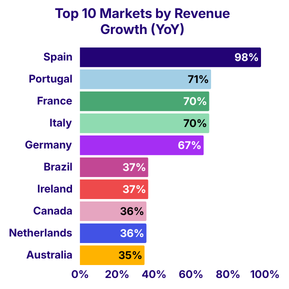
The acceleration in Spain and France is partly attributable to the European Accessibility Act (EAA), which came into full effect in June 2025. The EAA mandates that digital products and services—including ebooks and digital reading platforms—meet specific accessibility standards. For publishers who lacked the technical infrastructure to immediately comply, this created a near-term shift toward print formats, which are not subject to the same digital accessibility requirements. In Spain and France specifically, this regulatory pressure appears to have accelerated a digital-to-print transition among mid-size publishers, contributing to the outsized unit growth visible in both markets.
Germany's print performance deserves special attention. The Tolino Alliance and German retail store network recorded +869% growth in storefront network access—meaning the number of retail touchpoints available to independent publishers through this alliance expanded dramatically in the period. This was a one-time structural expansion of the retail network rather than organic sales growth. Underlying print revenue for the German market grew by approximately 60% year over year, which still represents strong performance and is consistent with Germany's mature print retail infrastructure, including the Tolino e-reader ecosystem and independent bookstore networks that are structurally distinct from the Amazon-dominated English-language market.
For authors and publishers considering expanding into non-English markets, print-on-demand through platforms like PublishDrive provides access to these regional retail ecosystems without requiring separate print partnerships in each territory.
PublishDrive's data cube reveals an even more striking story when we look at print unit growth alongside revenue. In the established English-language markets, unit growth tracks revenue growth relatively closely, consistent with steady pricing. But in the European growth markets, unit volume is expanding far faster than revenue—a signal of explosive demand adoption:
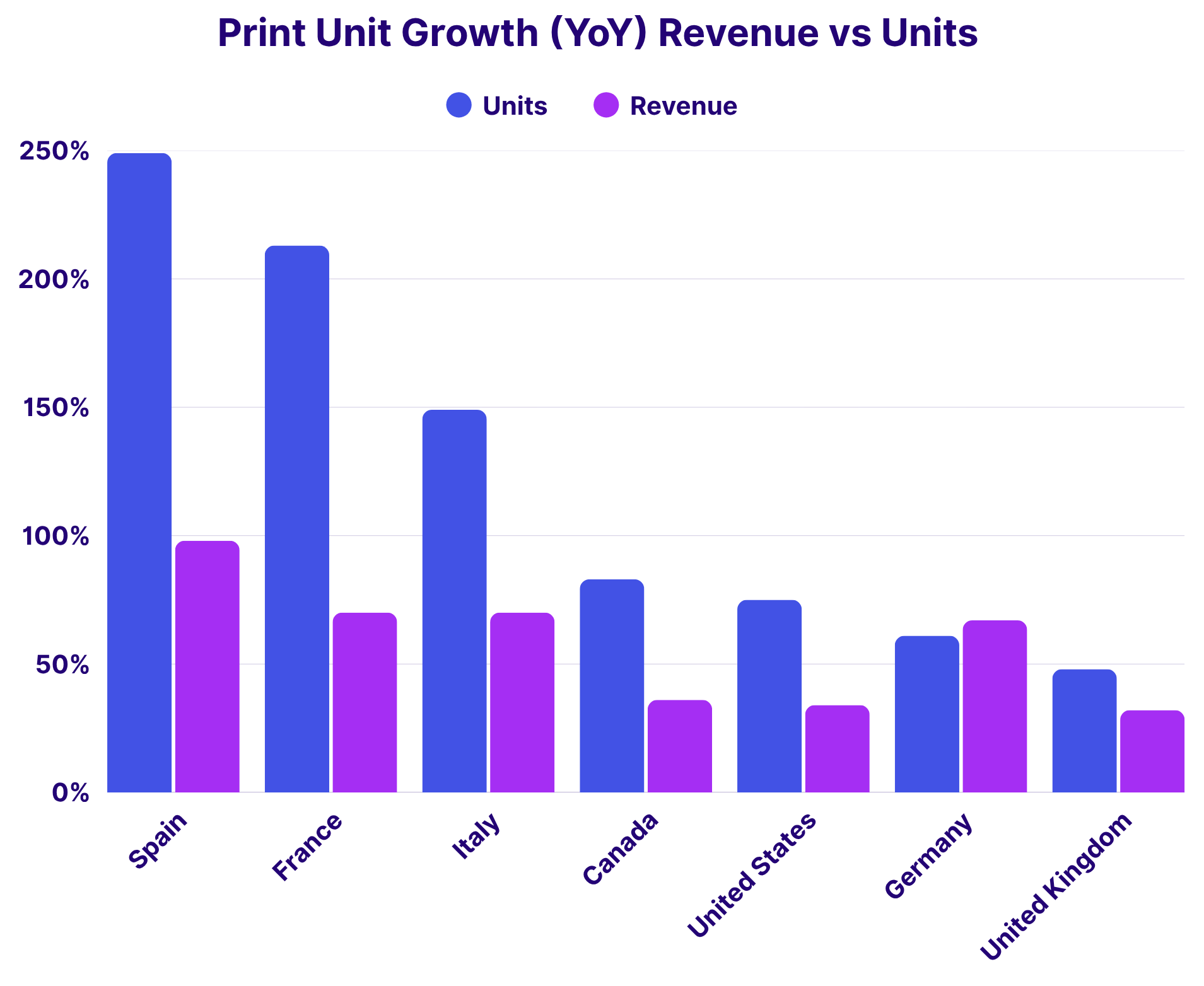
The pattern is revealing. In Spain, France, and Italy, print unit volume is growing 2–3× faster than revenue—meaning demand is flooding in, often at entry-level price points as new readers and retailers adopt POD for the first time. These are volume-led expansion markets, a dynamic further amplified in Spain and France by the accessibility-driven shift away from non-compliant digital formats described above. By contrast, Germany is the only European market where revenue growth (67%) actually outpaces unit growth (61%), indicating stronger per-unit monetization and a more mature print pricing structure. For authors targeting Europe, this distinction matters: some markets are ready for premium pricing, while others are still in a rapid adoption phase where visibility and availability drive the opportunity.
Print-on-Demand Across Genres: What's Selling in Print?
The report shows that fiction accounts for 64% of total book sales revenue on PublishDrive's platform, with non-fiction making up the remaining 36%. However, non-fiction is growing faster—47% revenue growth versus fiction's 26%.
Within fiction, the genre dynamics are particularly interesting for print strategy:
Fantasy remains the single largest fiction category, representing 33% of fiction revenue and 21% of total platform revenue. Fantasy growth was primarily driven by ebook and print formats. Mystery & Detective emerged as the fastest-accelerating fiction genre at 126% YoY growth, with strong traction across diversified retail channels. Romance, the second-largest fiction category, grew 17% YoY and was primarily driven by ebook expansion.
For non-fiction, the fastest-growing categories were Computers (+140%), Religion (+53%), and Business & Economics (+21%), reflecting sustained demand for professional development, digital literacy, and applied knowledge content.
How Subscription and Library Channels Affect Print Strategy
While print-on-demand is inherently a retail-driven format, the broader distribution ecosystem influences print performance indirectly. The report shows that subscription and library channels are growing substantially: Kobo Plus recorded 150% revenue growth, Hoopla grew by 69%, and OverDrive expanded by 64%.
These channels primarily serve ebook and audiobook consumption, but their growth signals expanding reader bases that may convert to print purchases. Authors who maintain visibility across subscription and library platforms often see downstream print sales as readers discover titles digitally and then purchase physical copies.
PublishDrive's all-in-one distribution model supports this cross-format discovery strategy, enabling authors to list ebooks, audiobooks, and print editions across 400+ stores and libraries from a single platform.
AI-Generated Content and Print: What the Data Shows
AI-driven production is increasingly visible within the independent publishing ecosystem. According to the report, AI-generated ebooks produced 10× higher sales value year over year in 2025, indicating rapid experimentation and scaling.
However, the AI content landscape for print is more nuanced. Not all stores currently accept AI-generated content, which limits print distribution scale for AI-produced titles. PublishDrive follows and implements content disclosure guidelines as outlined by its retail and distribution partners, ensuring compliance across participating channels.
For print-on-demand specifically, the combination of AI-assisted writing, AI narration for companion audiobooks, and traditional print production creates a multi-format publishing workflow that is increasingly accessible to independent authors.
How to Publish a Print-on-Demand Book via PublishDrive
For authors looking to capitalize on these trends, PublishDrive offers a streamlined path to print-on-demand distribution. Here's how the process works:
Prepare Your Print-Ready Files
- You'll need a print-ready interior PDF (formatted to your chosen trim size) and a cover file that includes the front cover, spine, and back cover. PublishDrive provides trim size guidelines compatible with major POD printers.
Upload and Configure Your Title on PublishDrive
- Log into your PublishDrive account and create a new title. Upload your interior and cover files, then fill in your metadata: title, subtitle, author name, description, categories (BISAC codes), and keywords. Metadata quality directly affects discoverability—use specific, relevant keywords.
Set Your Print Pricing
- PublishDrive shows you the printing cost per unit based on your page count, trim size, and paper type. You then set your retail list price. The margin between the printing cost and your list price (minus distribution fees) is your royalty. The report's data showing 75% revenue growth in print suggests that there is room for competitive yet profitable pricing.
- To put real numbers on this: printing costs vary by printer, trim size, and page count, but here's what typical scenarios look like across PublishDrive's network:
- 300-page · 6×9 · $14.99 list
- Printing cost: $2.90 – $7.07
- depending on printer
- 200-page · 5.5×8.5 · $12.99 list
- Printing cost: $2.00 – $5.26
- depending on printer
- Across all print titles on the PublishDrive platform, the average royalty per print sale is $7.14. For context, the average ebook royalty per sale is $2.48—though that figure is compressed by the inclusion of free and deeply discounted promotional titles, which are far more common in digital than in print. Even accounting for that, print delivers meaningfully higher per-unit revenue to authors, which is a key reason the format's 75% revenue growth is outpacing every other channel.
Select Your Distribution Channels
- This is where PublishDrive's wide distribution model becomes a competitive advantage. From a single dashboard, you can distribute your print-on-demand book to Amazon Print (the largest single print channel, 71% YoY revenue growth) and Ingram Distribution (reaching bookstores, libraries, and wholesalers globally; 96% YoY growth). By enabling both channels simultaneously, you gain access to the two infrastructure pillars driving print growth in 2025.
Publish and Monitor Performance
- Once you hit publish, PublishDrive handles the print production and fulfillment logistics. Books are printed when ordered—no inventory risk, no upfront costs. You can monitor sales, royalties, and channel performance through PublishDrive's analytics dashboard. Given the data showing strong print growth across multiple geographies, it's worth monitoring which markets generate the most traction for your titles and adjusting your metadata and pricing accordingly.
What These Trends Mean for Independent Authors in 2026
The 2025 data paints a clear picture: print-on-demand has moved from a supplementary format to a core revenue driver. The 75% revenue growth rate, the dual-channel infrastructure expansion through Amazon Print and Ingram, and the accelerating demand across European markets all point to a format that rewards strategic investment.
Key Takeaways for Independent Authors
- Print is no longer optional. If you're only publishing ebooks, you're leaving the fastest-growing revenue stream on the table.
- Wide distribution matters. The strongest growth is coming from publishers and authors who distribute through both Amazon Print and Ingram—not just one.
- European markets are expanding. Spain, Portugal, France, Italy, and Germany are all showing 60–98% print revenue growth. Regulatory shifts such as the European Accessibility Act are accelerating print adoption in key markets. If your content translates well into these markets, the opportunity is material.
- Pricing power exists in print. Revenue is growing faster than units, meaning the market supports higher price points for physical books.
- Multi-format strategies win. Authors who combine ebooks, audiobooks, and print across multiple channels are positioned to capture the full breadth of reader demand. Note that author-level audio revenue appears stagnant in the 2025 data due to platform transition effects—not because audiobooks lack an audience. Establishing audio distribution now positions authors well for when reporting normalizes.
PublishDrive's platform is designed precisely for this kind of multi-format, wide-distribution strategy. With access to Amazon Print, Ingram, 400+ digital stores, and regional retail alliances—all from a single account—it removes the operational friction that historically made wide publishing difficult for independent authors.
Frequently Asked Questions
How fast is the print-on-demand market growing?
According to the PublishDrive Market Intelligence Report 2026, print-on-demand revenue grew by 75% year over year between 2024 and 2025, making it the fastest-growing book format by revenue. Unit volume grew by 42% in the same period.
Is print-on-demand more profitable than ebooks?
On PublishDrive's platform, the average royalty per print sale is $7.14, compared to $2.48 for ebooks. The ebook figure is compressed by free and deeply discounted promotional titles, but even so, print delivers meaningfully higher per-unit revenue. Print's average retail price also rose 15% year over year (from $19.88 to $22.88), and revenue growth (75%) is outpacing unit growth (42%), confirming improving monetization per copy.
What are the best distribution channels for print-on-demand books?
The two fastest-growing print channels are Amazon Print (71% YoY revenue growth) and Ingram Distribution (96% YoY growth). Publishing through both channels maximizes reach—Amazon for its retail marketplace, and Ingram for access to physical bookstores, libraries, and wholesalers. PublishDrive lets you distribute to both from a single platform.
Which genres sell best in print-on-demand format?
Fiction accounts for 64% of total book sales revenue on the PublishDrive platform, with Fantasy as the largest single genre (21% of total revenue). Mystery & Detective fiction is the fastest-growing genre at 126% YoY. In non-fiction, Computers (+140%), Religion (+53%), and Business & Economics (+21%) lead growth.
Which countries have the highest print-on-demand growth?
Spain leads with 98% YoY revenue growth, followed by Portugal (71%), France (70%), Italy (70%), and Germany (67%). The United States and United Kingdom remain the largest markets by absolute volume, but European markets are accelerating fastest. The European Accessibility Act has contributed to print adoption growth in Spain and France in particular.
How do I publish a print-on-demand book through PublishDrive?
You can publish a POD book through PublishDrive in five steps: prepare your print-ready interior PDF and cover file, upload and configure your title metadata on PublishDrive, set your retail price based on printing costs and desired margin, select distribution channels (Amazon Print and/or Ingram), and publish. PublishDrive handles all production and fulfillment—no upfront inventory costs.
Can I distribute my print-on-demand book to bookstores?
Yes. Through PublishDrive's integration with Ingram Distribution (which grew 96% in revenue in 2025), your print-on-demand books become available to bookstores, libraries, and academic retailers worldwide. Combined with Amazon Print distribution, this gives your title maximum physical retail visibility.
How is AI affecting print-on-demand publishing?
AI-generated ebook content saw 10× higher sales value growth in 2025. However, print-on-demand distribution for AI content is limited by retailer acceptance policies, which vary by channel. PublishDrive follows disclosure guidelines set by its distribution partners. The broader trend shows AI lowering production barriers—particularly in audiobook narration—while traditional print remains primarily human-produced content.
Is audiobook publishing still worth pursuing for independent authors?
Yes. While PublishDrive's internal data shows author-level audio revenue as stagnant for the 2024–2025 reporting period, this reflects a transitional phase in audio distribution rights and subscription model payout structures rather than declining consumer demand. Industry-wide audiobook growth for independent publishers has ranged between 15–22% in recent years. The platform-specific figures for this period are best understood as a temporary reporting effect. Authors who invest in audio distribution now are well-positioned to benefit as the market normalizes.

Start Publishing Print-on-Demand Today
Distribute your print book to Amazon Print, Ingram, and 400+ stores from one platform. No inventory. No upfront costs.
GET STARTED WITH PUBLISHDRIVE