
Parts of a Book: Front Matter, Body, and Back Matter, Explained
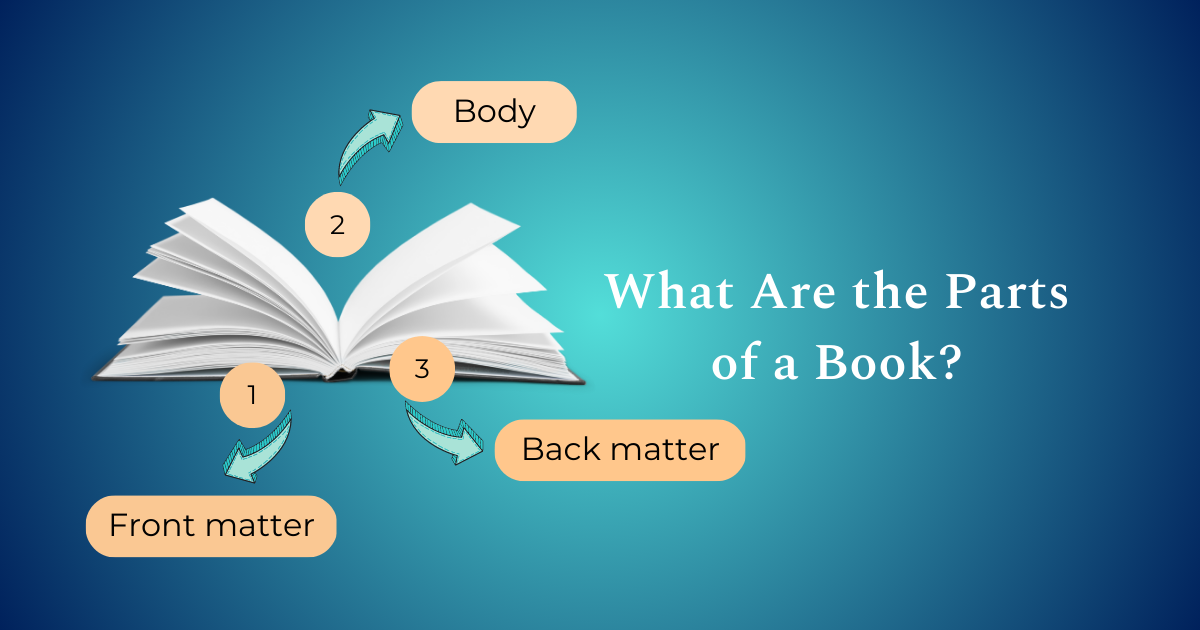
A finished book is more than a collection of chapters. Most books are divided into three main sections: front matter, the body, and back matter.
Front matter appears before the main text and contains information such as the title page, copyright page, dedication, table of contents, foreword, or preface. The body contains the book's primary content, while back matter comes after it and may include acknowledgments, appendices, endnotes, a glossary, bibliography, index, or author bio.
Not every book needs every element. What you include depends on your genre, book format, and the purpose of the publication.
In this guide, we'll look at the parts of a book in order, what each section is for, and which elements you may want to include when preparing your book for publication.
What Are the Main Parts of a Book?
A book is typically divided into three main parts:
- Front matter: Everything that appears before the main text.
- Body: The main content of the book.
- Back matter: Supplementary content that appears after the main text.
These sections help organize a book and make it easier for readers to understand, navigate, and reference its content.
Parts of a book at a glance
| Section | Purpose | Common elements |
|---|---|---|
| Front matter | Introduces and identifies the book | Title page, copyright page, dedication, table of contents, foreword, preface |
| Body | Contains the main content | Prologue, introduction, chapters, parts, conclusion, epilogue |
| Back matter | Adds supplementary or supporting information | Acknowledgments, appendix, endnotes, glossary, bibliography, index, author bio |
Parts of a Book in Order
There is no single structure that every book must follow. A novel will normally have different requirements from a textbook, memoir, academic work, or business book.
However, a typical book may follow this order:
| Section | Element | Usually required? |
|---|---|---|
| Front matter | Half title | Optional |
| Title page | Recommended | |
| Copyright page | Recommended | |
| Dedication | Optional | |
| Epigraph | Optional | |
| Table of contents | Depends on genre and format | |
| Foreword | Optional | |
| Preface | Optional | |
| Acknowledgments | Optional | |
| Introduction | Depends on the book | |
| Body | Prologue | Optional |
| Chapters or main text | Yes | |
| Conclusion | Depends on the book | |
| Epilogue | Optional | |
| Back matter | Acknowledgments | Optional |
| Appendix | Optional | |
| Endnotes | Optional | |
| Glossary | Optional | |
| Bibliography or references | Optional | |
| Index | Mainly nonfiction and print | |
| About the author | Recommended | |
| Also by the author | Optional |
You do not need to include every element. The important thing is to choose the sections that genuinely help readers understand or navigate your book.
What Is Front Matter in a Book?
Front matter is everything that appears before the main body of a book.
Its purpose is usually to identify the book, provide legal and publishing information, help readers navigate the content, or introduce the work before the main text begins.
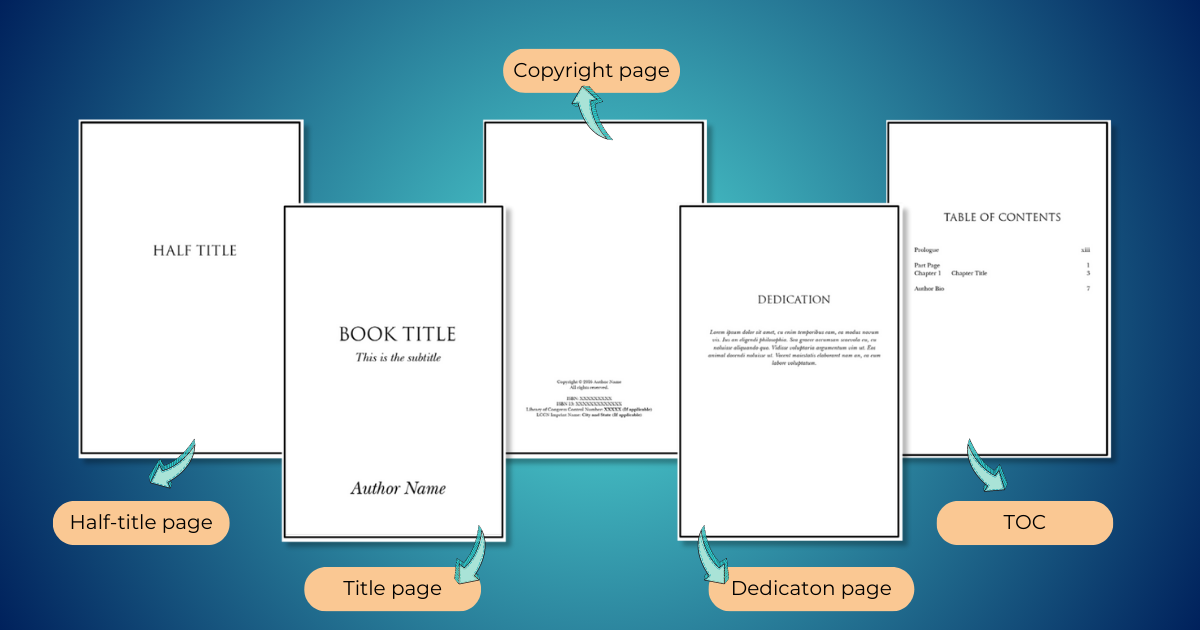
Depending on the type of book, front matter can include a half title, title page, copyright page, dedication, epigraph, table of contents, foreword, preface, acknowledgments, or introduction.
What Goes in the Front Matter of a Book?
Let's look at the most common front matter elements.
Half Title
The half-title page contains only the title of the book.
It usually appears before the full title page and does not normally include the author's name, subtitle, publisher, or other information.
A half title is common in traditionally designed print books but is not essential for every publication.
Title Page
The title page identifies the book and normally includes:
- Book title
- Subtitle, if applicable
- Author name
- Publisher or imprint
The title page is one of the most important elements of front matter because it formally identifies the work.
For ebooks, the title and author information should also match the book metadata submitted to retailers as closely as possible.
If you're still deciding how to style your book title, see our guide to book title punctuation and capitalization.
Copyright Page
The copyright page contains legal and publication information about the book.
It may include:
- Copyright notice
- Copyright year
- Name of the copyright holder
- Publisher information
- Edition information
- ISBN
- Credits for editors, designers, illustrators, or photographers
- Legal disclaimers
- Permissions information
The exact information you include depends on the book and where it is being published.
Dedication
A dedication is a short message from the author dedicating the book to a person, group, or cause.
It is usually only one or two lines long and appears on its own page.
For example:
For my family, who made this possible.
A dedication is completely optional.
Epigraph
An epigraph is a quotation, phrase, poem excerpt, or short passage placed near the beginning of a book.
Authors often use epigraphs to introduce a theme, mood, or idea that connects with the book.
If you use copyrighted material, make sure you have the appropriate permission where required.
Table of Contents
A table of contents lists the main sections or chapters of a book.
It is especially important in nonfiction, reference books, textbooks, and other books where readers may want to jump directly to a particular section.
For reflowable ebooks, the table of contents should be navigable so readers can select a chapter title and go directly to that section.
Foreword
A foreword is an introductory section written by someone other than the author.
It is often written by an expert, notable person, colleague, or someone with a connection to the subject of the book.
A foreword can help establish credibility by explaining why the book or author is worth readers' attention.
It should not be confused with a preface, which is normally written by the author.
Preface
A preface is written by the author and explains something about the creation, background, or purpose of the book.
The author might discuss:
- Why they wrote the book
- How the idea developed
- Their experience with the subject
- Research or methodology
- Changes made in a new edition
A preface is more common in nonfiction than fiction.
Acknowledgments
Acknowledgments allow the author to thank the people or organizations that contributed to the book.
This might include:
- Editors
- Researchers
- Beta readers
- Family members
- Professional advisers
- Organizations
- Funding sources
Acknowledgments can appear in either the front matter or back matter.
Many modern books place them at the end so readers can reach the main content more quickly.
Introduction
An introduction prepares the reader for the main content of the book.
In nonfiction, it may explain:
- What the book covers
- Who the book is for
- Why the subject matters
- How the book is organized
- What the reader can expect to learn
Unlike a preface, an introduction is generally part of the content itself and directly helps readers understand the subject.
What Is the Body of a Book?
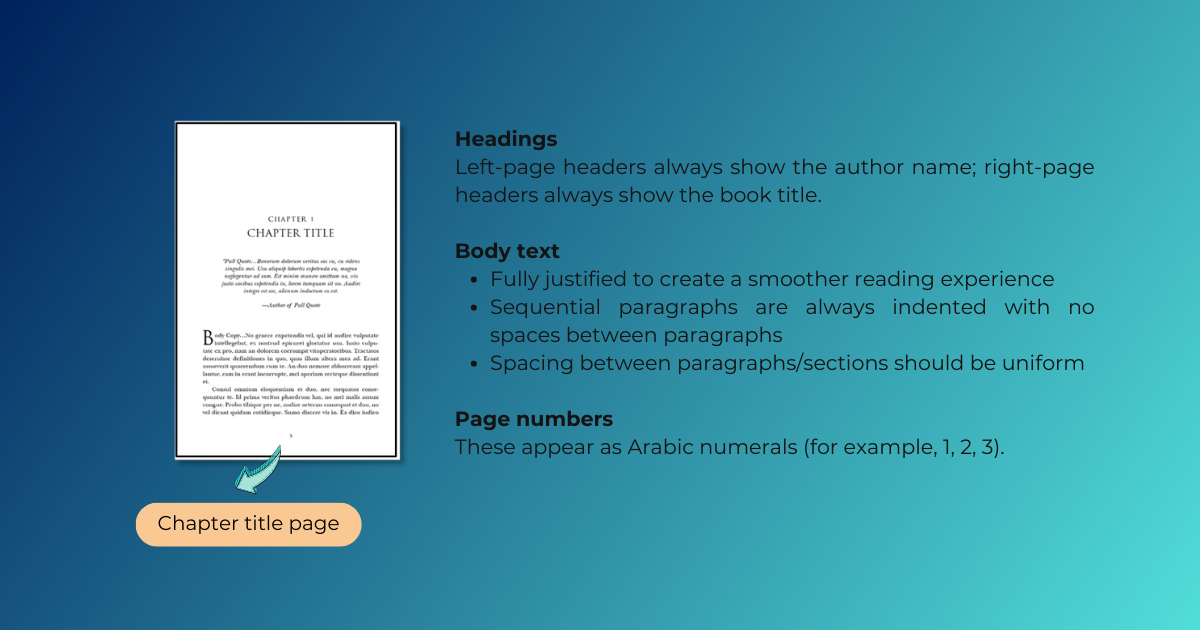
The body is the main content of the book.
This is where the story, argument, information, or central subject of the book is developed.
For most books, the body consists primarily of chapters, but it can also include parts, sections, prologues, introductions, conclusions, or epilogues.
Prologue
A prologue is an optional section that appears before the first chapter.
It is most commonly used in fiction to provide background, introduce an earlier event, establish context, or show something that takes place outside the main narrative.
A prologue should have a clear purpose. If the same information could naturally be included in the opening chapters, a separate prologue may not be necessary.
Introduction
In nonfiction, the introduction often forms the beginning of the main body rather than the front matter.
It introduces the subject and prepares readers for the chapters that follow.
Whether you treat an introduction as front matter or part of the body depends on the type and structure of the book.
Chapters
Chapters form the core structure of most books.
Each chapter should represent a logical section of the story or subject matter.
Longer nonfiction books may also divide chapters into larger sections or parts.
For example:
Part One: Getting Started
- Chapter 1
- Chapter 2
- Chapter 3
Part Two: Building Your Strategy
- Chapter 4
- Chapter 5
- Chapter 6
The most important thing is consistency and clear navigation.
Print and ebook formatting work differently, so if you're preparing a digital edition, see our complete guide on how to format an ebook.
Conclusion
A conclusion is most common in nonfiction.
It summarizes the main ideas of the book and helps bring the argument, lesson, or discussion to a close.
A strong conclusion may also give readers practical next steps or reinforce the most important takeaway.
Epilogue
An epilogue appears after the main story has ended and is most common in fiction.
It may show what happened to the characters later, resolve unanswered questions, or provide additional context after the main narrative.
Afterword
An afterword appears after the main text and provides additional commentary about the work.
It may be written by the author or by another person familiar with the book, its subject, or its significance.
What Is Back Matter in a Book?
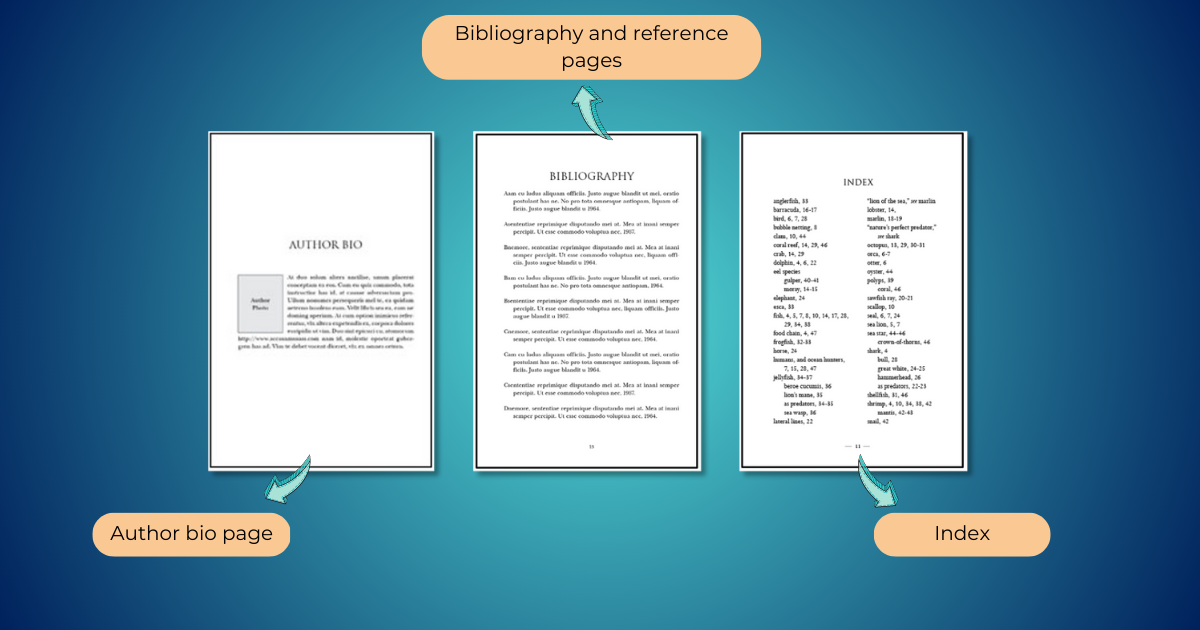
Back matter is the material that appears after the main text of a book.
It is used to provide supplementary information, references, resources, additional context, or information about the author.
Back matter is especially common in nonfiction, but fiction authors can also use it to encourage readers to discover other books or learn more about the author.
What Goes in the Back Matter of a Book?
Common back matter elements include the following.
Acknowledgments
If acknowledgments were not included in the front matter, they can appear after the main text.
This is often a good choice because it allows readers to begin the book more quickly while still giving the author space to thank contributors.
About the Author
An author biography tells readers more about the person behind the book.
It may include:
- Professional background
- Relevant experience
- Previous books
- Awards or recognition
- Website
- Social media or other ways to connect
For self-published authors, this section can also help build a longer-term relationship with readers.
Keep the bio relevant to the book and audience rather than treating it as a complete résumé. For more examples and tips, see our guide to creating an effective About the Author page.
Copyright Permissions
If your book reproduces copyrighted material with permission, the appropriate permissions or credits may be included in the back matter.
This can include information about excerpts, photographs, illustrations, lyrics, or other third-party material used in the book.
Appendix
An appendix contains supplementary material that supports the main text but would interrupt the flow if it were included within the chapters.
An appendix may contain:
- Additional data
- Charts
- Tables
- Research material
- Documents
- Templates
- Case studies
- Technical details
A book can have one appendix or several.
Chronology
A chronology presents events in date order and can help readers understand a complex sequence of historical, biographical, or fictional events.
Depending on the book, a chronology may be a standalone section or part of an appendix.
Endnotes
Endnotes provide citations, explanations, comments, or references relating to specific parts of the text.
Unlike footnotes, which appear at the bottom of a page, endnotes are collected together toward the end of the book.
They are commonly used in academic, historical, and research-based nonfiction.
Glossary
A glossary provides definitions of specialist, technical, uncommon, or subject-specific terms used in the book.
It is particularly useful when readers may not already be familiar with the terminology.
Glossaries are common in:
- Academic books
- Technical books
- Educational material
- Fantasy
- Science fiction
- Business books
Bibliography or References
A bibliography lists books, articles, websites, studies, documents, or other sources used in the creation of a book.
A references section usually lists sources that were directly cited in the text.
The exact format depends on the type of publication and the citation style being used.
Index
An index is an alphabetical list of important topics, names, and concepts along with the pages where they appear.
Indexes are especially useful in nonfiction and reference books.
They are primarily a print concept because traditional indexes rely on fixed page numbers. Reflowable ebooks may instead rely on search, navigation, hyperlinks, or other digital features.
Also by the Author
An "Also by the Author" section lists other books written by the same author.
This can be particularly useful for fiction series, authors with a large backlist, or publishers trying to help readers discover related titles.
You may also include short descriptions or links where appropriate in an ebook.
Front Matter vs. Back Matter
The main difference between front matter and back matter is where they appear and what they are designed to do.
| Front matter | Back matter | |
|---|---|---|
| Location | Before the main text | After the main text |
| Main purpose | Identify, introduce, and organize the book | Supplement, reference, or conclude the book |
| Common elements | Title page, copyright page, dedication, TOC, foreword, preface | Acknowledgments, appendix, endnotes, glossary, bibliography, index, author bio |
| Required? | Some elements are strongly recommended | Most elements are optional |
| Used in ebooks? | Yes | Yes |
Both sections should serve the reader. If an element does not add useful information, help navigation, or support the book, you may not need it.
Is Front Matter Different in an Ebook?
The basic purpose of front matter is the same in print books and ebooks, but the formatting can differ.
A print book has fixed pages, so book designers can control whether a section appears on the left-hand or right-hand page.
A reflowable ebook does not work in the same way. Readers can change font size, screen size, orientation, and other display settings, which means page positions are not fixed.
This affects several parts of a book.
Table of Contents
A print table of contents typically uses page numbers.
An ebook should have a navigable table of contents that links directly to chapters and major sections.
Page Position
Rules such as starting a section on a right-hand page are relevant to print design but generally do not apply to a reflowable ebook.
Page Numbers
Reflowable ebooks do not rely on traditional fixed page numbering in the same way print books do.
For this reason, navigation and internal linking become much more important.
Images and Decorative Pages
Highly designed front matter may need to be simplified or adapted for smaller screens.
Always check how the ebook displays across different screen sizes and reading environments before publishing.
You can learn more about the differences and limitations in our guide to ebook formatting.
Preparing Front Matter for Ebook Conversion
If you are preparing a manuscript for ebook conversion, keep the structure clean and consistent.
Your manuscript should contain the content you want to appear in the finished book, including relevant front matter and back matter.
Typical elements include:
- Title page
- Copyright information
- Main manuscript
- Acknowledgments, if used
- About the author
- Other relevant back matter
Avoid trying to recreate a print layout inside a Word document using spaces, tabs, or repeated line breaks. Ebook formatting works best when the document uses clear paragraph styles, headings, and a logical content hierarchy.
If you're preparing a DOCX file, follow PublishDrive's step-by-step guide on how to format a manuscript for ebook conversion.
Once the manuscript is ready, you can use PublishDrive's free ebook converter to convert a DOCX manuscript to EPUB.
Authors publishing directly through PublishDrive can also upload a DOCX file for conversion as part of the publishing workflow.
Front Matter and Back Matter Checklist
Before publishing your book, use this checklist to make sure its structure is complete.
Front Matter
- ✓ Title page
- ✓ Copyright page
- ✓ Dedication, if needed
- ✓ Epigraph, if needed
- ✓ Navigable table of contents for ebooks
- ✓ Foreword, if applicable
- ✓ Preface, if applicable
- ✓ Introduction, if applicable
Body
- ✓ Chapters are in the correct order
- ✓ Chapter headings are formatted consistently
- ✓ Parts or sections are clearly labeled
- ✓ Prologue or epilogue is included if needed
- ✓ Conclusion is included where appropriate
Back Matter
- ✓ Acknowledgments, if needed
- ✓ Appendix, if needed
- ✓ Endnotes, if needed
- ✓ Glossary, if needed
- ✓ Bibliography or references, if needed
- ✓ Index for print, if needed
- ✓ About the author
- ✓ Other books by the author
- ✓ Relevant links or reader resources
You do not need to check every box. The goal is to include the elements that make sense for your book and help create a professional reading experience.
Frequently Asked Questions About the Parts of a Book
What are the three main parts of a book?
The three main parts of a book are front matter, the body, and back matter. Front matter comes before the main text, the body contains the primary content, and back matter appears after the main text.
What comes first in a book?
The front matter comes first. A book usually begins with a half-title or title page, followed by information such as the copyright page and other introductory material.
What is included in front matter?
Front matter can include the half title, title page, copyright page, dedication, epigraph, table of contents, foreword, preface, acknowledgments, and introduction. Not every book needs all of these elements.
What is included in back matter?
Back matter can include acknowledgments, appendices, endnotes, a glossary, bibliography, references, index, author biography, and a list of other books by the author.
Is a foreword the same as a preface?
No. A foreword is normally written by someone other than the author and introduces or recommends the book. A preface is written by the author and usually explains the background, purpose, or creation of the book.
Is an introduction part of the front matter?
It depends on the book. In some nonfiction books, the introduction is considered part of the front matter. In others, it is treated as the beginning of the main body because it directly introduces the book's subject.
Does a table of contents go in the front matter?
Yes. A table of contents normally appears in the front matter. For ebooks, it should also be navigable so readers can move directly to chapters and major sections.
Does a novel need a table of contents?
Not necessarily. Many novels do not need a visible table of contents, particularly when chapters are simply numbered. However, ebooks should still have appropriate internal navigation so reading systems can identify the book's structure.
Does an ebook need front matter?
Yes. Ebooks still use front matter, although the formatting may differ from print books. Core elements such as the title page and copyright information remain useful, while print-specific conventions such as fixed page positions are generally not relevant to reflowable ebooks.
Can acknowledgments go at the beginning or end of a book?
Yes. Acknowledgments can appear in either the front matter or back matter. Many authors place them at the end so readers can reach the main content more quickly.
What should go at the end of an ebook?
The end of an ebook can include acknowledgments, an author bio, information about other books, reader resources, or other relevant back matter. For authors publishing a series or multiple books, the end of the ebook can also be a useful place to help readers discover the next title.
Prepare Your Book for Publishing
Once your manuscript, front matter, body, and back matter are in the right order, the next step is preparing your book for publication and distribution.
That means making sure your files are correctly formatted, your book metadata is accurate, your cover is ready, and your book can meet the requirements of the stores and libraries where you want it to appear.
If you're new to publishing, our complete guide to self-publishing a book takes you through the broader publishing process.
PublishDrive helps authors and publishers distribute ebooks, audiobooks, and print books through stores and library networks from one platform.
You can manage your titles, metadata, distribution, sales reporting, and royalties in one place while making your books available to readers around the world.
Ready to publish your book?